 HackTricks
Libc Heap
Tip
Ucz się i ćwicz Hacking AWS:
HackTricks Training AWS Red Team Expert (ARTE)
Ucz się i ćwicz Hacking GCP:HackTricks Training GCP Red Team Expert (GRTE)
HackTricks Training Azure Red Team Expert (AzRTE)
Wsparcie dla HackTricks
- Sprawdź plany subskrypcyjne!
- Dołącz do 💬 grupy Discord lub grupy telegramowej lub śledź nas na Twitterze 🐦 @hacktricks_live.
- Dziel się trikami hackingowymi, przesyłając PR-y do HackTricks i HackTricks Cloud repozytoriów na githubie.
Podstawy heapu
The heap is basically the place where a program is going to be able to store data when it requests data calling functions like malloc, calloc… Moreover, when this memory is no longer needed it’s made available calling the function free.
As it’s shown, its just after where the binary is being loaded in memory (check the [heap] section):
.png)
Podstawowa alokacja chunków
When some data is requested to be stored in the heap, some space of the heap is allocated to it. This space will belong to a bin and only the requested data + the space of the bin headers + minimum bin size offset will be reserved for the chunk. The goal is to just reserve as minimum memory as possible without making it complicated to find where each chunk is. For this, the metadata chunk information is used to know where each used/free chunk is.
There are different ways to reserver the space mainly depending on the used bin, but a general methodology is the following:
- The program starts by requesting certain amount of memory.
- If in the list of chunks there someone available big enough to fulfil the request, it’ll be used
- This might even mean that part of the available chunk will be used for this request and the rest will be added to the chunks list
- If there isn’t any available chunk in the list but there is still space in allocated heap memory, the heap manager creates a new chunk
- If there is not enough heap space to allocate the new chunk, the heap manager asks the kernel to expand the memory allocated to the heap and then use this memory to generate the new chunk
- If everything fails,
mallocreturns null.
Note that if the requested memory passes a threshold, mmap will be used to map the requested memory.
Arenas
In multithreaded applications, the heap manager must prevent race conditions that could lead to crashes. Initially, this was done using a global mutex to ensure that only one thread could access the heap at a time, but this caused performance issues due to the mutex-induced bottleneck.
To address this, the ptmalloc2 heap allocator introduced “arenas,” where each arena acts as a separate heap with its own data structures and mutex, allowing multiple threads to perform heap operations without interfering with each other, as long as they use different arenas.
The default “main” arena handles heap operations for single-threaded applications. When new threads are added, the heap manager assigns them secondary arenas to reduce contention. It first attempts to attach each new thread to an unused arena, creating new ones if needed, up to a limit of 2 times the number of CPU cores for 32-bit systems and 8 times for 64-bit systems. Once the limit is reached, threads must share arenas, leading to potential contention.
Unlike the main arena, which expands using the brk system call, secondary arenas create “subheaps” using mmap and mprotect to simulate the heap behaviour, allowing flexibility in managing memory for multithreaded operations.
Subheaps
Subheaps serve as memory reserves for secondary arenas in multithreaded applications, allowing them to grow and manage their own heap regions separately from the main heap. Here’s how subheaps differ from the initial heap and how they operate:
- Initial Heap vs. Subheaps:
- The initial heap is located directly after the program’s binary in memory, and it expands using the
sbrksystem call. - Subheaps, used by secondary arenas, are created through
mmap, a system call that maps a specified memory region.
- Memory Reservation with
mmap:
- When the heap manager creates a subheap, it reserves a large block of memory through
mmap. This reservation doesn’t allocate memory immediately; it simply designates a region that other system processes or allocations shouldn’t use. - By default, the reserved size for a subheap is 1 MB for 32-bit processes and 64 MB for 64-bit processes.
- Gradual Expansion with
mprotect:
- The reserved memory region is initially marked as
PROT_NONE, indicating that the kernel doesn’t need to allocate physical memory to this space yet. - To “grow” the subheap, the heap manager uses
mprotectto change page permissions fromPROT_NONEtoPROT_READ | PROT_WRITE, prompting the kernel to allocate physical memory to the previously reserved addresses. This step-by-step approach allows the subheap to expand as needed. - Once the entire subheap is exhausted, the heap manager creates a new subheap to continue allocation.
heap_info
This struct allocates relevant information of the heap. Moreover, heap memory might not be continuous after more allocations, this struct will also store that info.
// From https://github.com/bminor/glibc/blob/a07e000e82cb71238259e674529c37c12dc7d423/malloc/arena.c#L837

typedef struct _heap_info
{
mstate ar_ptr; /* Arena for this heap. */
struct _heap_info *prev; /* Previous heap. */
size_t size;   /* Current size in bytes. */
size_t mprotect_size; /* Size in bytes that has been mprotected
PROT_READ|PROT_WRITE.  */
size_t pagesize; /* Page size used when allocating the arena.  */
/* Make sure the following data is properly aligned, particularly
that sizeof (heap_info) + 2 * SIZE_SZ is a multiple of
MALLOC_ALIGNMENT. */
char pad[-3 * SIZE_SZ & MALLOC_ALIGN_MASK];
} heap_info;
malloc_state
Każdy heap (main arena lub areny innych wątków) ma strukturę malloc_state.
Ważne jest, że struktura main arena malloc_state jest zmienną globalną w libc (czyli znajduje się w przestrzeni pamięci libc).
W przypadku struktur malloc_state dla heapów wątków, znajdują się one wewnątrz własnego “heap” wątku.
Jest kilka ciekawych rzeczy w tej strukturze (zobacz kod C poniżej):
-
__libc_lock_define (, mutex);służy do zapewnienia, że do tej struktury z heapu uzyskuje dostęp tylko jeden wątek naraz -
Flagi:
-
#define NONCONTIGUOUS_BIT (2U)
#define contiguous(M) (((M)->flags & NONCONTIGUOUS_BIT) == 0) #define noncontiguous(M) (((M)->flags & NONCONTIGUOUS_BIT) != 0) #define set_noncontiguous(M) ((M)->flags |= NONCONTIGUOUS_BIT) #define set_contiguous(M) ((M)->flags &= ~NONCONTIGUOUS_BIT)
- Zmienna `mchunkptr bins[NBINS * 2 - 2];` zawiera **wskaźniki** do **pierwszych i ostatnich chunków** małych, dużych i niesortowanych **bins** (to -2, ponieważ indeks 0 nie jest używany)
- Dlatego **pierwszy chunk** tych bins będzie miał **backwards pointer do tej struktury**, a **ostatni chunk** tych bins będzie miał **forward pointer** do tej struktury. Co zasadniczo oznacza, że jeśli możesz l**eak** te adresy w main arena, będziesz miał wskaźnik do struktury w **libc**.
- Struktury `struct malloc_state *next;` i `struct malloc_state *next_free;` tworzą linked listy aren
- `top` chunk jest ostatnim "chunkiem", który w zasadzie obejmuje **całą pozostałą przestrzeń heapu**. Gdy top chunk jest "pusty", heap jest całkowicie wykorzystany i musi zażądać więcej przestrzeni.
- `last reminder` chunk powstaje w sytuacjach, gdy chunk o dokładnym rozmiarze nie jest dostępny, więc większy chunk jest podzielony, a pozostała część jest umieszczana tutaj.
```c
// From https://github.com/bminor/glibc/blob/a07e000e82cb71238259e674529c37c12dc7d423/malloc/malloc.c#L1812

struct malloc_state
{
/* Serialize access.  */
__libc_lock_define (, mutex);

/* Flags (formerly in max_fast).  */
int flags;

/* Set if the fastbin chunks contain recently inserted free blocks.  */
/* Note this is a bool but not all targets support atomics on booleans.  */
int have_fastchunks;

/* Fastbins */
mfastbinptr fastbinsY[NFASTBINS];

/* Base of the topmost chunk -- not otherwise kept in a bin */
mchunkptr top;

/* The remainder from the most recent split of a small request */
mchunkptr last_remainder;

/* Normal bins packed as described above */
mchunkptr bins[NBINS * 2 - 2];

/* Bitmap of bins */
unsigned int binmap[BINMAPSIZE];

/* Linked list */
struct malloc_state *next;

/* Linked list for free arenas.  Access to this field is serialized
by free_list_lock in arena.c.  */
struct malloc_state *next_free;

/* Number of threads attached to this arena.  0 if the arena is on
the free list.  Access to this field is serialized by
free_list_lock in arena.c.  */
INTERNAL_SIZE_T attached_threads;

/* Memory allocated from the system in this arena.  */
INTERNAL_SIZE_T system_mem;
INTERNAL_SIZE_T max_system_mem;
};
malloc_chunk
Ta struktura reprezentuje konkretny chunk pamięci. Poszczególne pola mają inne znaczenie dla przydzielonych i nieprzydzielonych chunków.
// https://github.com/bminor/glibc/blob/master/malloc/malloc.c
struct malloc_chunk {
INTERNAL_SIZE_T      mchunk_prev_size;  /* Size of previous chunk, if it is free. */
INTERNAL_SIZE_T      mchunk_size;       /* Size in bytes, including overhead. */
struct malloc_chunk* fd;                /* double links -- used only if this chunk is free. */
struct malloc_chunk* bk;
/* Only used for large blocks: pointer to next larger size.  */
struct malloc_chunk* fd_nextsize; /* double links -- used only if this chunk is free. */
struct malloc_chunk* bk_nextsize;
};

typedef struct malloc_chunk* mchunkptr;
Jak wspomniano wcześniej, te chunky mają również pewne metadata, bardzo dobrze przedstawione na tym obrazku:
.png)
https://azeria-labs.com/wp-content/uploads/2019/03/chunk-allocated-CS.png
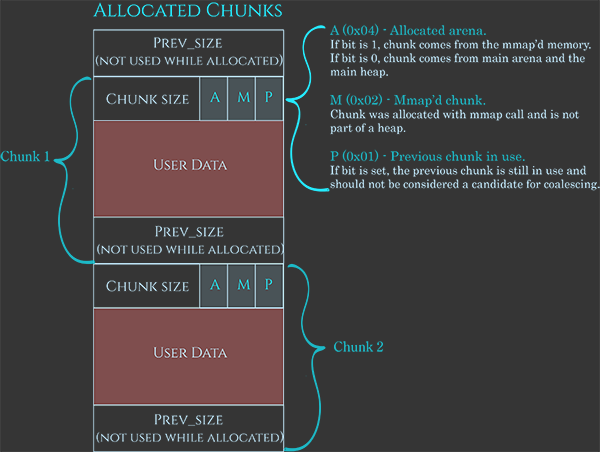
Metadata zazwyczaj to 0x08B wskazujące aktualny rozmiar chunku, wykorzystując ostatnie 3 bity do oznaczenia:
A: Jeśli 1 — pochodzi z subheap, jeśli 0 — znajduje się w main arenaM: Jeśli 1 — ten chunk jest częścią obszaru zaalokowanego przy użyciu mmap i nie należy do heapP: Jeśli 1 — poprzedni chunk jest w użyciu
Następnie miejsce na dane użytkownika, a na końcu 0x08B aby wskazać rozmiar poprzedniego chunku, gdy chunk jest dostępny (lub do przechowywania danych użytkownika, gdy jest zaalokowany).
Co więcej, gdy są dostępne, dane użytkownika są również wykorzystywane do przechowywania pewnych informacji:
fd: Pointer to the next chunkbk: Pointer to the previous chunkfd_nextsize: Pointer to the first chunk in the list is smaller than itselfbk_nextsize: Pointer to the first chunk the list that is larger than itself
.png)
https://azeria-labs.com/wp-content/uploads/2019/03/chunk-allocated-CS.png
Tip
Zauważ, że połączenie listy w ten sposób eliminuje potrzebę posiadania tablicy, w której każdy pojedynczy chunk byłby rejestrowany.
Chunk Pointers
When malloc is used a pointer to the content that can be written is returned (just after the headers), however, when managing chunks, it’s needed a pointer to the begining of the headers (metadata).
For these conversions these functions are used:
// https://github.com/bminor/glibc/blob/master/malloc/malloc.c

/* Convert a chunk address to a user mem pointer without correcting the tag.  */
#define chunk2mem(p) ((void*)((char*)(p) + CHUNK_HDR_SZ))

/* Convert a user mem pointer to a chunk address and extract the right tag.  */
#define mem2chunk(mem) ((mchunkptr)tag_at (((char*)(mem) - CHUNK_HDR_SZ)))

/* The smallest possible chunk */
#define MIN_CHUNK_SIZE        (offsetof(struct malloc_chunk, fd_nextsize))

/* The smallest size we can malloc is an aligned minimal chunk */

#define MINSIZE  \
(unsigned long)(((MIN_CHUNK_SIZE+MALLOC_ALIGN_MASK) & ~MALLOC_ALIGN_MASK))
Wyrównanie i minimalny rozmiar
Wskaźnik na chunk i 0x0f muszą być równe 0.
// From https://github.com/bminor/glibc/blob/a07e000e82cb71238259e674529c37c12dc7d423/sysdeps/generic/malloc-size.h#L61
#define MALLOC_ALIGN_MASK (MALLOC_ALIGNMENT - 1)

// https://github.com/bminor/glibc/blob/a07e000e82cb71238259e674529c37c12dc7d423/sysdeps/i386/malloc-alignment.h
#define MALLOC_ALIGNMENT 16


// https://github.com/bminor/glibc/blob/master/malloc/malloc.c
/* Check if m has acceptable alignment */
#define aligned_OK(m)  (((unsigned long)(m) & MALLOC_ALIGN_MASK) == 0)

#define misaligned_chunk(p) \
((uintptr_t)(MALLOC_ALIGNMENT == CHUNK_HDR_SZ ? (p) : chunk2mem (p)) \
& MALLOC_ALIGN_MASK)


/* pad request bytes into a usable size -- internal version */
/* Note: This must be a macro that evaluates to a compile time constant
if passed a literal constant.  */
#define request2size(req)                                         \
(((req) + SIZE_SZ + MALLOC_ALIGN_MASK < MINSIZE)  ?             \
MINSIZE :                                                      \
((req) + SIZE_SZ + MALLOC_ALIGN_MASK) & ~MALLOC_ALIGN_MASK)

/* Check if REQ overflows when padded and aligned and if the resulting
value is less than PTRDIFF_T.  Returns the requested size or
MINSIZE in case the value is less than MINSIZE, or 0 if any of the
previous checks fail.  */
static inline size_t
checked_request2size (size_t req) __nonnull (1)
{
if (__glibc_unlikely (req > PTRDIFF_MAX))
return 0;

/* When using tagged memory, we cannot share the end of the user
block with the header for the next chunk, so ensure that we
allocate blocks that are rounded up to the granule size.  Take
care not to overflow from close to MAX_SIZE_T to a small
number.  Ideally, this would be part of request2size(), but that
must be a macro that produces a compile time constant if passed
a constant literal.  */
if (__glibc_unlikely (mtag_enabled))
{
/* Ensure this is not evaluated if !mtag_enabled, see gcc PR 99551.  */
asm ("");

req = (req + (__MTAG_GRANULE_SIZE - 1)) &
~(size_t)(__MTAG_GRANULE_SIZE - 1);
}

return request2size (req);
}
Zwróć uwagę, że przy obliczaniu całkowitej potrzebnej przestrzeni SIZE_SZ jest dodawane tylko raz, ponieważ pole prev_size może być użyte do przechowywania danych, więc potrzebny jest tylko początkowy nagłówek.
Pobieranie danych Chunk i modyfikacja metadanych
Te funkcje przyjmują wskaźnik do chunk i są przydatne do sprawdzania/ustawiania metadanych:
- Sprawdź flagi chunka
// From https://github.com/bminor/glibc/blob/master/malloc/malloc.c


/* size field is or'ed with PREV_INUSE when previous adjacent chunk in use */
#define PREV_INUSE 0x1

/* extract inuse bit of previous chunk */
#define prev_inuse(p)       ((p)->mchunk_size & PREV_INUSE)


/* size field is or'ed with IS_MMAPPED if the chunk was obtained with mmap() */
#define IS_MMAPPED 0x2

/* check for mmap()'ed chunk */
#define chunk_is_mmapped(p) ((p)->mchunk_size & IS_MMAPPED)


/* size field is or'ed with NON_MAIN_ARENA if the chunk was obtained
from a non-main arena.  This is only set immediately before handing
the chunk to the user, if necessary.  */
#define NON_MAIN_ARENA 0x4

/* Check for chunk from main arena.  */
#define chunk_main_arena(p) (((p)->mchunk_size & NON_MAIN_ARENA) == 0)

/* Mark a chunk as not being on the main arena.  */
#define set_non_main_arena(p) ((p)->mchunk_size |= NON_MAIN_ARENA)
- Rozmiary i pointers do innych chunks
/*
Bits to mask off when extracting size

Note: IS_MMAPPED is intentionally not masked off from size field in
macros for which mmapped chunks should never be seen. This should
cause helpful core dumps to occur if it is tried by accident by
people extending or adapting this malloc.
*/
#define SIZE_BITS (PREV_INUSE | IS_MMAPPED | NON_MAIN_ARENA)

/* Get size, ignoring use bits */
#define chunksize(p) (chunksize_nomask (p) & ~(SIZE_BITS))

/* Like chunksize, but do not mask SIZE_BITS.  */
#define chunksize_nomask(p)         ((p)->mchunk_size)

/* Ptr to next physical malloc_chunk. */
#define next_chunk(p) ((mchunkptr) (((char *) (p)) + chunksize (p)))

/* Size of the chunk below P.  Only valid if !prev_inuse (P).  */
#define prev_size(p) ((p)->mchunk_prev_size)

/* Set the size of the chunk below P.  Only valid if !prev_inuse (P).  */
#define set_prev_size(p, sz) ((p)->mchunk_prev_size = (sz))

/* Ptr to previous physical malloc_chunk.  Only valid if !prev_inuse (P).  */
#define prev_chunk(p) ((mchunkptr) (((char *) (p)) - prev_size (p)))

/* Treat space at ptr + offset as a chunk */
#define chunk_at_offset(p, s)  ((mchunkptr) (((char *) (p)) + (s)))
Czy miałeś na myśli “Insue bit”, “Ensue bit” czy “Issue bit”? Proszę o doprecyzowanie, przetłumaczę po wyjaśnieniu.
/* extract p's inuse bit */
#define inuse(p)							      \
((((mchunkptr) (((char *) (p)) + chunksize (p)))->mchunk_size) & PREV_INUSE)

/* set/clear chunk as being inuse without otherwise disturbing */
#define set_inuse(p)							      \
((mchunkptr) (((char *) (p)) + chunksize (p)))->mchunk_size |= PREV_INUSE

#define clear_inuse(p)							      \
((mchunkptr) (((char *) (p)) + chunksize (p)))->mchunk_size &= ~(PREV_INUSE)


/* check/set/clear inuse bits in known places */
#define inuse_bit_at_offset(p, s)					      \
(((mchunkptr) (((char *) (p)) + (s)))->mchunk_size & PREV_INUSE)

#define set_inuse_bit_at_offset(p, s)					      \
(((mchunkptr) (((char *) (p)) + (s)))->mchunk_size |= PREV_INUSE)

#define clear_inuse_bit_at_offset(p, s)					      \
(((mchunkptr) (((char *) (p)) + (s)))->mchunk_size &= ~(PREV_INUSE))
- Ustaw head i footer (gdy chunk nos są w użyciu)
/* Set size at head, without disturbing its use bit */
#define set_head_size(p, s)  ((p)->mchunk_size = (((p)->mchunk_size & SIZE_BITS) | (s)))

/* Set size/use field */
#define set_head(p, s)       ((p)->mchunk_size = (s))

/* Set size at footer (only when chunk is not in use) */
#define set_foot(p, s)       (((mchunkptr) ((char *) (p) + (s)))->mchunk_prev_size = (s))
Uzyskaj rozmiar rzeczywistych, użytecznych danych wewnątrz chunk
#pragma GCC poison mchunk_size
#pragma GCC poison mchunk_prev_size

/* This is the size of the real usable data in the chunk.  Not valid for
dumped heap chunks.  */
#define memsize(p)                                                    \
(__MTAG_GRANULE_SIZE > SIZE_SZ && __glibc_unlikely (mtag_enabled) ? \
chunksize (p) - CHUNK_HDR_SZ :                                    \
chunksize (p) - CHUNK_HDR_SZ + (chunk_is_mmapped (p) ? 0 : SIZE_SZ))

/* If memory tagging is enabled the layout changes to accommodate the granule
size, this is wasteful for small allocations so not done by default.
Both the chunk header and user data has to be granule aligned.  */
_Static_assert (__MTAG_GRANULE_SIZE <= CHUNK_HDR_SZ,
"memory tagging is not supported with large granule.");

static __always_inline void *
tag_new_usable (void *ptr)
{
if (__glibc_unlikely (mtag_enabled) && ptr)
{
mchunkptr cp = mem2chunk(ptr);
ptr = __libc_mtag_tag_region (__libc_mtag_new_tag (ptr), memsize (cp));
}
return ptr;
}
Przykłady
Szybki przykład Heap
Szybki przykład heap z https://guyinatuxedo.github.io/25-heap/index.html, ale dla arm64:
#include <stdio.h>
#include <stdlib.h>
#include <string.h>

void main(void)
{
char *ptr;
ptr = malloc(0x10);
strcpy(ptr, "panda");
}
Ustaw breakpoint na końcu main function i sprawdźmy, gdzie została zapisana informacja:
.png)
Widać, że string panda został zapisany pod adresem 0xaaaaaaac12a0 (który był adresem zwróconym przez malloc w x0). Sprawdzając 0x10 bajtów wcześniej można zobaczyć, że 0x0 oznacza, że previous chunk is not used (length 0) oraz że długość tego chunku to 0x21.
Dodatkowe zarezerwowane bajty (0x21-0x10=0x11) pochodzą od added headers (0x10), a 0x1 nie oznacza, że zarezerwowano 0x21B — oznacza to, że ostatnie 3 bity wartości długości bieżącego headera mają szczególne znaczenie. Ponieważ length jest zawsze wyrównana do 16 bajtów (w maszynach 64-bitowych), te bity w praktyce nigdy nie są używane przez wartość długości.
0x1:     Previous in Use     - Specifies that the chunk before it in memory is in use
0x2:     Is MMAPPED          - Specifies that the chunk was obtained with mmap()
0x4:     Non Main Arena      - Specifies that the chunk was obtained from outside of the main arena
Przykład wielowątkowości
Wielowątkowość
```c #includevoid* threadFuncMalloc(void* arg) { printf(“Hello from thread 1\n”); char* addr = (char*) malloc(1000); printf(“After malloc and before free in thread 1\n”); free(addr); printf(“After free in thread 1\n”); }
void* threadFuncNoMalloc(void* arg) { printf(“Hello from thread 2\n”); }
int main() { pthread_t t1; void* s; int ret; char* addr;
printf(“Before creating thread 1\n”); getchar(); ret = pthread_create(&t1, NULL, threadFuncMalloc, NULL); getchar();
printf(“Before creating thread 2\n”); ret = pthread_create(&t1, NULL, threadFuncNoMalloc, NULL);
printf(“Before exit\n”); getchar();
return 0; }
</details>

Debugując poprzedni przykład, widać, że na początku jest tylko 1 arena:

<figure><img src="../../images/image (1) (1) (1) (1) (1) (1) (1) (1) (1).png" alt=""><figcaption></figcaption></figure>

Następnie, po uruchomieniu pierwszego threadu — tego, który wywołuje malloc — tworzona jest nowa arena:

<figure><img src="../../images/image (1) (1) (1) (1) (1) (1) (1) (1) (1) (1).png" alt=""><figcaption></figcaption></figure>

wewnątrz można znaleźć kilka chunks:

<figure><img src="../../images/image (2) (1) (1) (1) (1) (1).png" alt=""><figcaption></figcaption></figure>

## Bins & Memory Allocations/Frees

Sprawdź, jakie są Bins i jak są zorganizowane oraz jak pamięć jest alokowana i zwalniana w:


<a class="content_ref" href="bins-and-memory-allocations.md"><span class="content_ref_label">Bins & Memory Allocations</span></a>

## Heap Functions Security Checks

Funkcje związane z heapem wykonują określone kontrole przed wykonaniem swoich operacji, aby upewnić się, że heap nie został uszkodzony:


<a class="content_ref" href="heap-memory-functions/heap-functions-security-checks.md"><span class="content_ref_label">Heap Functions Security Checks</span></a>

## musl mallocng exploitation notes (Alpine)

- **Slab group/slot grooming for huge linear copies:** mallocng sizeclasses używają mmap()'d grup, których sloty są całkowicie `munmap()`'d, gdy są puste. Dla długich linear copies (~0x15555555 bytes) trzymaj span zmapowany (unikaj dziur wynikających ze zwolnionych grup) i umieść victim allocation bezpośrednio obok source slot.
- **Cycling offset mitigation:** Przy ponownym użyciu slotu mallocng może przesunąć początek user-data o wielokrotności `UNIT` (0x10), gdy slack mieści dodatkowy 4-bajtowy nagłówek. To przesuwa overwrite offsets (np. trafienia w LSB wskaźnika), chyba że kontrolujesz reuse counts lub trzymasz się stride'ów bez slacka (np. Lua `Table` objects at stride 0x50 pokazują offset 0). Inspect offsets with muslheap’s `mchunkinfo`:
```gdb
pwndbg> mchunkinfo 0x7ffff7a94e40
... stride: 0x140
... cycling offset : 0x1 (userdata --> 0x7ffff7a94e40)
- Preferuj korupcję obiektów w czasie wykonywania zamiast metadanych alokatora: mallocng miesza cookies/guarded out-of-band metadata, więc celuj w obiekty wyższego poziomu. W Redis’s Lua 5.1,
Table->arraywskazuje na tablicę wartościTValuez tagami; nadpisanie LSB wskaźnika wTValue->value(np. bajtem terminatora JSON0x22) może przekierować referencje bez modyfikowania metadanych malloc. - Debugowanie stripped/static Lua na Alpine: Zbuduj odpowiadającą wersję Lua, wypisz symbole za pomocą
readelf -Ws, usuń symbole funkcji używającobjcopy --strip-symbol, aby ujawnić układy struktur w GDB, następnie użyj pretty-printerów z obsługą Lua (GdbLuaExtension for Lua 5.1) oraz muslheap, aby sprawdzić wartości stride/reserved/cycling-offset przed wywołaniem przepełnienia.
Studium przypadków
Przeanalizuj prymitywy specyficzne dla alokatora pochodzące z rzeczywistych błędów:
Virtualbox Slirp Nat Packet Heap Exploitation
Gnu Obstack Function Pointer Hijack
Referencje
- https://azeria-labs.com/heap-exploitation-part-1-understanding-the-glibc-heap-implementation/
- https://azeria-labs.com/heap-exploitation-part-2-glibc-heap-free-bins/
- Pumping Iron on the Musl Heap – Real World CVE-2022-24834 Exploitation on an Alpine mallocng Heap
- musl mallocng enframe (v1.2.4)
- muslheap GDB plugin
- GdbLuaExtension (Lua 5.1 support)
Tip
Ucz się i ćwicz Hacking AWS:
Ucz się i ćwicz Hacking GCP:Wsparcie dla HackTricks
- Sprawdź plany subskrypcyjne!
- Dołącz do 💬 grupy Discord lub grupy telegramowej lub śledź nas na Twitterze 🐦 @hacktricks_live.
- Dziel się trikami hackingowymi, przesyłając PR-y do HackTricks i HackTricks Cloud repozytoriów na githubie.